- Home
- Tested by a Bogey Golfer
- Testing Equipment as an Average Golfer
- 4 Scorecard Apps Tested
I Tried 4 Golf Scorecard Apps in One Summer. Only One Survived September.
I had four scorecard apps on my phone at the same time this summer. Two I paid for. One wanted to sync with a rangefinder I don't own and never stopped asking. All four, at some point on some Saturday, buzzed in my back pocket while I was standing over a putt, and I couldn't tell you what a single one of those notifications said.
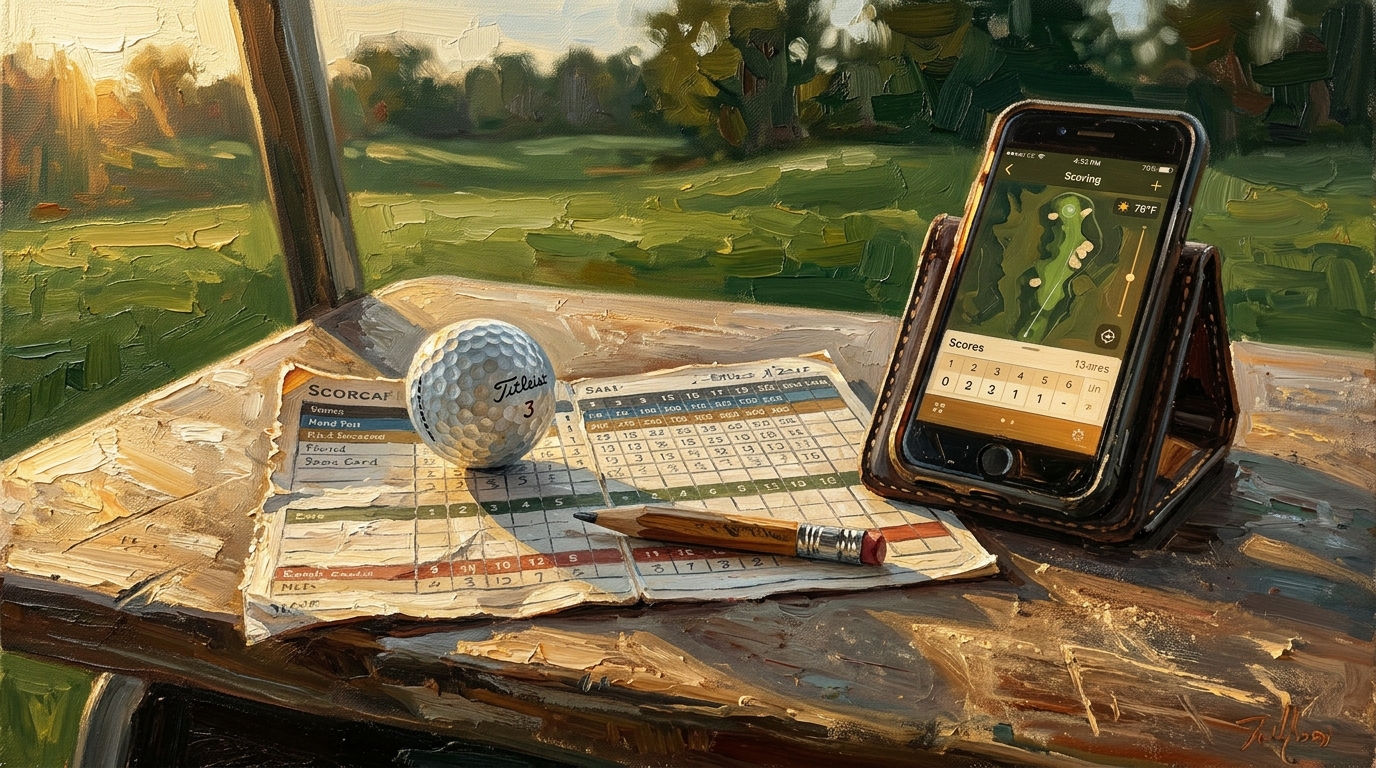
The pencil in my pocket outlasted every free trial.
The short version: I tested four different golf scorecard apps over one full season of weekend rounds — a stats-heavy one, a bare-bones one, a social-leaderboard one, and a GPS-and-stats hybrid — and only one is still on my phone. It's not the fanciest of the four. It's the one that got out of the way fastest, which turned out to be the whole point.
Here's the thing nobody talks about with scorecard apps: the review sites rank them on features. Nobody ranks them on how it feels to be the guy fumbling with his phone on the tee box while three other guys are already walking to their carts. That's the test that actually matters to a weekend group, and it's the one I ran.
Improving my own experience — the round, the group, the day, not just the number on the card — applies just as much to the gear in your pocket as it does to the games you play. An app that makes the round better belongs. An app that makes you the guy everyone's waiting on doesn't, no matter how good its handicap tracking is.
Why I Even Bothered Testing Four of These
Here's how it started: my buddy Dave asked me what changed after I showed up three weeks running with actual fairway-hit percentages instead of just a final number. I told him I'd started using an app. He asked which one. I didn't have a good answer, because at that point I was using two of them badly and hating a third.
That's a category of Saturday-morning problem most of us have quietly ignored for years. You know your score. You maybe know your putts, if you remembered to count. Beyond that, weekend golfers are mostly guessing at their own game — not because we don't care, but because tracking anything beyond the number on the card has always meant carrying a second scorecard's worth of admin that nobody signed up for.
So I picked four apps that cover the real range of what's out there — one built for stat obsessives, one built to do nothing but hold your score, one built around comparing your round to your friends', and one built around GPS distances with scoring bolted on — and I used each one for a real stretch, not a single round. A single round tells you if an app is confusing. It doesn't tell you if it's worth keeping.
This isn't the first time I've put gear through a full season instead of a single round for Tested by a Bogey Golfer. I've quit premium balls for six months, played 18 holes without a driver, and tried a rangefinder for the first time — and the pattern holds every time: the thing that looks best in a store demo isn't always the thing that survives contact with an actual Saturday group.
App One: The One With Every Stat Imaginable
This is the app that made me feel, for about two weeks, like I'd been playing golf wrong my entire life. Fairways hit, greens in regulation, strokes gained off the tee, strokes gained on approach, strokes gained around the green, strokes gained putting — categories I didn't know existed, all populated after every single hole if I tagged my shots correctly.
The problem showed up on hole four of my very first round with it. Tagging a shot means stopping, pulling out the phone, picking a lie type from a menu, picking a shot shape, picking a result — and doing that six or seven times a hole if you actually want the data to mean anything. I fell a hole and a half behind my group by the turn, entering data from three shots ago while they waited on the tee.
What actually changed: by round three, I'd stopped tagging shots mid-round and started trying to reconstruct them from memory in the clubhouse afterward, which is exactly the kind of after-the-fact guessing the app was supposed to fix. The stats were real. The cost of getting them wasn't worth what a bogey golfer actually does with strokes-gained data, which — if I'm honest — is nothing. I look at the number, nod, and go back to trying to hit more fairways.
If you want a sense of what those numbers should even look like for a golfer like us before you get lost chasing strokes-gained categories that don't mean much yet, I broke it down separately in what a real 20-handicap's stats actually look like.
Verdict on this one: the data was genuinely good. The tax on the round was too high for a guy who plays for the group, not the spreadsheet.
App Two: The Bare-Bones One I Almost Deleted on Day One
I nearly deleted this one before I'd finished the front nine. No GPS, no stat categories, no course maps — just a scorecard with a plus and minus button for strokes and a second row for putts. My first reaction, honestly, was that I'd downloaded the wrong thing.
Then I noticed I wasn't noticing it. Tap plus a few times on the green, tap the putts row once, put the phone back in my pocket, and I was walking to the next tee with everyone else instead of three steps behind them. Four holes in, Mike asked what happened to the fancy app from a few weeks before. I told him I switched. He said he hadn't seen me check my phone once all day, which — from Mike, mid-round — is close to a compliment.
Here's what changed over the rest of that round and the ones after it: I actually finished entering scores in real time, every hole, for the first time all summer, because it took four seconds instead of forty. The trade-off is real — I have a final score and a putt count and basically nothing else. No fairways, no GIR, no idea if my second-shot problem is distance or direction. For a guy who mostly wants to know if this Saturday beat last Saturday, that turned out to be plenty.
That putts row, for what it's worth, lined up with what I found when I dug into real putts per round for an average golfer — most of us three-putt more than we'd guess, and just watching the number climb is its own kind of useful.
App Three: The Social One That Made My Group Uncomfortable
This app wants you checking a live leaderboard against your friends, posting your round to a feed, and reacting to everyone else's. On paper it sounds like exactly what a site about weekend golf and friendship should love. In practice, it turned my foursome into four guys quietly comparing themselves to each other in real time, which is a very different thing from four guys enjoying a round together.
The moment I knew it wasn't for us: Jim birdied 11, and instead of anyone saying anything out loud, two phones came out to check where that put him on the group leaderboard. Nobody said a word about the birdie itself. Something happened. Something changed — quietly, over about six holes, the conversation between shots thinned out and got replaced by phone-checking, and none of us had actually decided that trade felt worth it.
I don't think this app is bad. I think it's built for a different kind of golfer than the one Golfeaser is for — someone chasing rank against a specific group of people, all the time, as the point of playing. For a Saturday foursome trying to have a good four hours together, a live leaderboard is kinda like handing everyone a stopwatch at a dinner party — technically adds information, mostly adds pressure nobody asked for.
App Four: The One Still on My Phone
This is the GPS-and-scoring hybrid, and it's the one I'm still using in September. It shows front/center/back yardages to the green when you open it, keeps score with two taps, and logs fairways and greens in regulation automatically off your GPS position — no shot-tagging menu required.
It's not as deep as the stats-obsessive app. It won't tell you your strokes gained on approach shots from 100–125 yards. What it will tell you, with almost no effort from me, is the three numbers I actually check afterward: score, fairways hit, greens in regulation. That's enough to see whether a bad round was really a driving problem or a wedge problem, without ever pulling me out of the round to get it.
The distances turned out to matter more than I expected going in — not because I didn't know my yardages on the courses I play most, but because on the two new courses I played this summer, having the number without pulling out a rangefinder kept the pace moving. Three of my regular group play the same eight or nine courses on rotation, and for that kind of golfer, an app that maps distances on courses you'll play again and again earns its download in a way it wouldn't for someone hopping to a new course every trip.
It's basically the same question I already ran down when I put a GPS watch up against a phone app — and the same fix that mattered when I finally stopped guessing my club distances altogether. A number you don't have to guess at beats a number you're pretty sure about.
I'm not totally sure why, but knowing the exact number instead of eyeballing it got me to actually hit two extra fairways on the back nine at a course I'd never played before. Might just be confidence. Either way, I'll take it.
📋 What Actually Happened When I Tested Four Scorecard Apps
- 😤 Before: A pocket full of paper cards, a rough idea of my score, and zero idea what actually costs me strokes
- 💡 The experiment: Four apps, one full season, real rounds with real groups — not single-round test drives
- 🎯 What changed: The two data-heavy apps got left in my back pocket unused by round three; the two simple ones got used every hole
- 🏌️ The verdict: The GPS-and-scoring hybrid stayed on my phone — enough data to be useful, little enough friction that I actually keep entering it
What Actually Matters When You're Picking One
Every scorecard app review I read before this test ranked apps on feature count. More stats, more course maps, more social tools, higher score. My four-app summer taught me the opposite lesson: the feature that matters most is how fast you can put the phone away.
If you play with a group that notices when you're on your phone — and if you play with the same guys most Saturdays, you almost certainly do — friction is the whole ballgame. An app that takes four seconds to log a hole gets used every hole. An app that takes forty seconds gets used for three holes and then abandoned in the cart, which means the data it eventually shows you is wrong anyway, built off guesswork you back-filled at the 19th hole. It doesn't matter whether you're behind a push cart, a carry bag, or a riding cart — the app that survives is the one that doesn't need you to stop walking to use it.
The other real variable is what you actually do with the data afterward. If you're the guy who genuinely studies strokes-gained numbers between rounds and adjusts practice around them, the stat-heavy app earns its complexity. If you're like most of us and mostly want to know whether you beat your last round, that complexity is a cost with no matching benefit — you paid in round-pace and got back a spreadsheet you'll never open twice. It's the same logic that shaped which clubs I actually decided I needed in the bag, and not far off from what changed when I got fit for clubs as a 20-handicapper — more precision isn't automatically more useful if you're not going to act on it.
The One Thing None of the Four Apps Fixed
None of this solved the actual problem I started the summer with, which wasn't really about data. It was about wanting to know, in some real way, whether I was getting better — and an app, any app, only ever answers that with a number. It doesn't answer it with the thing that actually made this feel worth doing: three friends comparing rounds at the same table afterward, which happens whether you tracked strokes gained or just wrote a number on a paper card.
I make my foursome better by being the guy who's ready to go, not the guy holding up the tee box fiddling with a shot-tagging menu — and by the end of the summer, that mattered more to me than any stat I collected. You're always just one round away from the one where all this actually clicks, app or no app, and no piece of software is going to be the thing that gets you there. It just gets to decide whether you're paying attention to your group or your phone while you wait.
⛳ The Scorecard App Test, Boiled Down
- ✅ Pick based on friction, not feature count — four seconds a hole gets used, forty seconds gets abandoned
- ⭐ Stat-heavy apps earn their complexity only if you'll actually study the numbers between rounds
- 🚫 Social/leaderboard apps can quietly turn a round into a comparison contest — watch what it does to the conversation
- 💡 GPS-and-scoring hybrids pay off most if you play the same handful of courses on rotation
- 🏌️ The winner isn't the app with the most data — it's the one you actually keep opening in October
🏌️ Got a Golf Story?
Share it with us. Every story we publish earns the author a free copy of The Weekend Golfer's Social Playbook — our three-step system for finding your people, running trips that actually come together, and earning the right to brag at the 19th hole.
Or join the Golfeasers — free weekly content for people like us.
Questions From Guys Who Just Want to Keep Score
Do I actually need a scorecard app, or is paper fine? Paper is genuinely fine if you only care about your final score. The reason an app is worth trying is the stuff paper can't give you — fairways hit, greens in regulation, putts per round over time — without you having to build a second scorecard by hand.
Will a scorecard app slow down my round? It can, and that was the biggest surprise of this whole test. The stat-heavy and social apps both cost real time per hole. The bare-bones and GPS-hybrid apps added almost none, because logging a score took two taps instead of a multi-step menu.
Do I need GPS distances if I already know my home course? Not really — GPS earns its keep more on courses you don't play every week, or on the handful of holes at your home course where the yardage markers are wrong or missing. If you play one course and know it cold, GPS is a nice-to-have, not a need-to-have.
Is it worth paying for a premium scorecard app? Only if you're going to use the features you're paying for. I paid for two of the four apps in this test and only kept using one of them — the lesson wasn't "spend more," it was "figure out which type fits you before you pay for anything."
What happens to my data if I switch apps like I did? You mostly lose the historical trend line, which stings a little the first time you switch. It's a fair trade for actually using an app instead of dragging around one you've stopped opening — a stat history nobody looks at isn't worth protecting.
Keep Testing Gear Before Your Next Round
- How Many Golf Balls You Actually Need in the Bag
- Mallet vs. Blade Putter: Does a Bogey Golfer Actually Feel the Difference
- Soft vs. Hard Golf Balls: What Actually Changes at a Bogey-Golfer Swing Speed
- I Tested 5 Golf Gloves for a Season

Johnny is a 25-year weekend golfer who's double-booked tee times, forgotten his clubs an hour from the course, and made pretty much every other trip-planning mistake there is — so you don't have to. Guided by The Golfeaser Manifesto, he started Golfeaser.com to prove that weekend golfers are a special, funnier breed who improve the experience, not just the scorecard. He's also the guy behind The Weekend Golfer's Social Playbook — a three-step system for finding your people, running trips that actually come together, and earning the right to brag at the 19th hole.
