- Home
- Tested by a Bogey Golfer
- Testing Equipment as an Average Golfer
- Soft vs. Hard Golf Balls
Soft vs. Hard Golf Balls: What Changed (and What Didn't) at My Actual Swing Speed
Dave held up a ball on the range last spring, turned it over like he was checking a mango for ripeness, and asked, "Wait, are you playing the soft ones or the real ones?" He wasn't being a jerk about it. He genuinely didn't know there was a difference, and neither did I — not really. I'd been buying whatever was on sale for about six years, alternating between a $25-a-dozen tour ball and a $18-a-dozen "soft feel" ball depending on what Dick's had stacked up front that week, with zero actual theory behind it.
That question sat with me longer than it should have. So I did the dumbest, most Golfeaser thing possible: I played a full month on a low-compression ball, then a full month on a firm tour ball, same course rotation, same three guys in my group, and wrote down what actually happened instead of what I assumed would happen. It's the same instinct behind everything in Tested by a Bogey Golfer — test the thing instead of repeating whatever the guy at the counter told you.
Here's the direct answer, before the story: at a bogey-golfer swing speed — call it 80 to 95 mph with the driver — a soft, low-compression ball and a firm, high-compression ball produce driver distance within a couple of yards of each other. The real difference shows up around the green, in how forgiving mis-hits feel, and in your wallet. If you're picking a ball based on chasing extra yardage off the tee, you're solving the wrong problem.
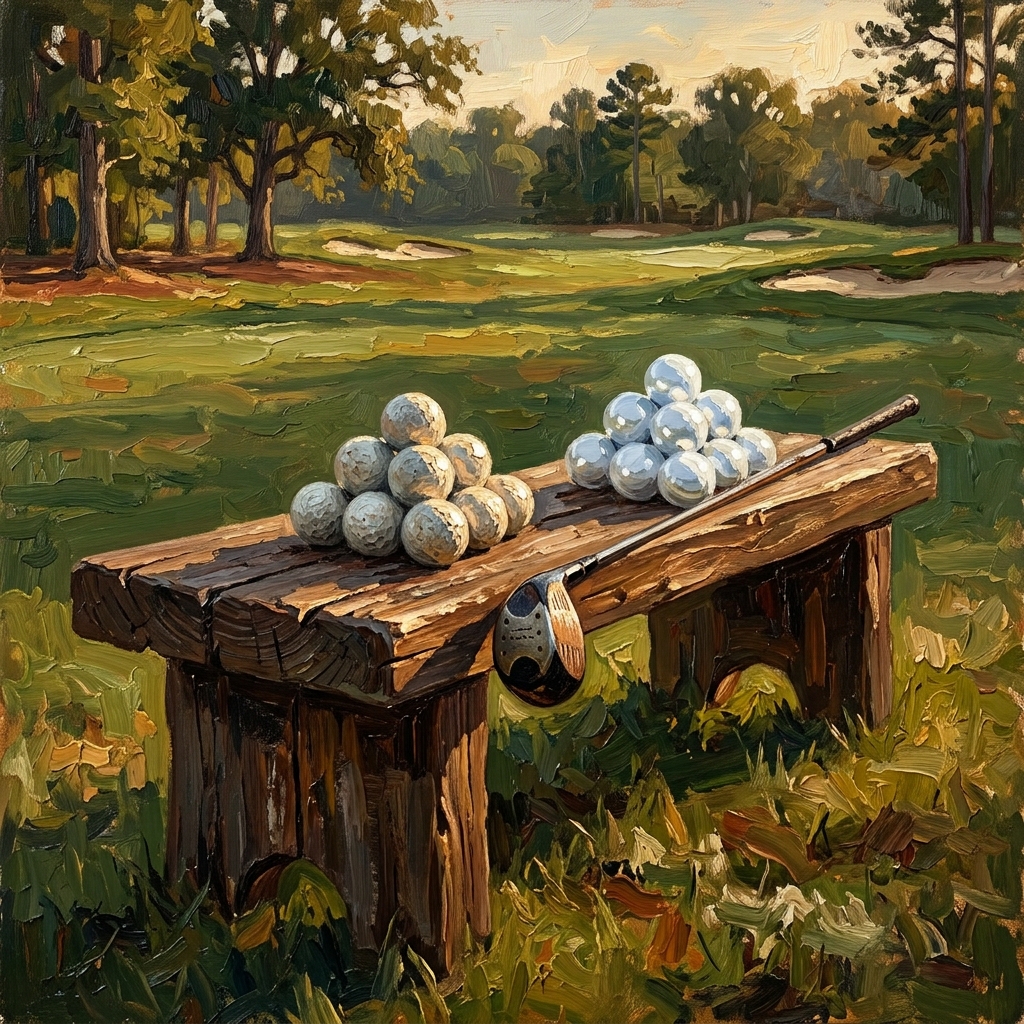
Six years of buying whatever was on sale, and it turns out I was closer to right than I had any business being.
I've been playing weekend golf for 25 years and I'm not about to pretend this month of testing turned me into a club fitter. What it did was answer a question I'd been quietly wrong about since I started — the kind of small course-correction that's basically the whole point of the Golfeaser Manifesto: improve your own experience, not just your scorecard.
What "Soft" and "Hard" Even Mean on a Golf Ball
What does golf ball compression actually measure? Compression is a rating of how much a ball deforms when it's struck — a low number means the ball squashes more at impact, a high number means it stays firmer. Manufacturers group balls roughly into three bands: low compression sits around 30 to 70, mid-range sits around 65 to 90, and high compression runs from about 90 up past 110. The general swing-speed guidance follows a similar shape — under 85 mph with the driver, a low-compression ball is usually the better match; 85 to 100 mph, you're in the mid-range window; north of 100 mph, that's where firm, high-compression tour balls earn their keep.
I'm not totally sure why nobody explained it to me in those plain terms years ago, but here's the reasoning once you see it: a slower swing doesn't generate enough clubhead speed to fully compress a stiff ball. You end up striking something that barely deforms, which means you're not getting the spring-like energy transfer the ball was actually designed around. A softer ball compresses more easily at that same speed, so more of your swing's energy actually goes into the ball instead of getting absorbed by a core that's too stiff for what you're bringing to it.
That's the theory. My swing speed with the driver sits right around 88 mph on a good day — the same number that came up when I got fit for clubs as a 20-handicapper — which put me squarely in that mid-range window. Not a clean case for either extreme, which is honestly why I wanted to test it instead of trust a chart.
The Month I Played Both Balls Back to Back
I didn't do a scientific split — I'm not equipped for that and neither is my Saturday group's patience. What I did: four rounds in a row on a low-compression ball (the kind built specifically for slower swings), then four rounds in a row on a firm tour ball (the kind built for faster swings and more spin control), same home course, same two carry clubs I trust, same three guys watching me either way.
Jim thought I'd lost my mind writing yardages in the notes app after every drive. Fair. But I wanted real numbers, not vibes, because vibes are exactly how I ended up buying balls off a Dick's endcap for six years — the same lazy logic I finally dropped when I worked out what golf clubs I actually need instead of what the catalog wanted to sell me.
Driver distance across both months: 214 yards average on the soft ball, 217 on the firm one. A three-yard gap, which is inside the range of a normal mis-hit and nowhere close to the kind of number that should decide anything. Fairways hit: almost identical — 7 of 14 on soft, 8 of 14 on firm, across a small sample that I won't pretend is statistically bulletproof.
📋 What Actually Happened When I Tested Soft vs. Firm Balls
- 😤 Before: Buying whatever was cheapest that week and assuming "harder must mean farther," with no actual reasoning behind either purchase
- 💡 The experiment: Four straight rounds on a low-compression ball, then four straight rounds on a firm tour ball, same course, same group
- 🎯 What changed: Driver distance moved by about three yards — noise, not signal. Greenside spin and how forgiving mis-hits felt moved a lot more
- 🏌️ The verdict: The ball isn't your distance problem at our swing speeds. It's your short-game feel problem, and that's a real difference worth having an opinion about
That's the part that surprised me. I went in assuming I'd find a clear distance winner and could just tell everyone in my group which one to buy. Instead I found the least dramatic result of my life — and a much more interesting one hiding right behind it.
What Actually Changes Around the Green
If driver distance barely moved, where did the difference go? It went into feel and spin — the stuff you notice on a 60-yard wedge shot, not off the tee. The soft ball, compressing more easily even on a shorter, slower-swing wedge shot, grabbed the green noticeably faster. My chip-and-runs on the firm ball consistently released two or three extra feet past where I expected. On the soft ball, a shot that landed short of the flag mostly stayed there.
Putting was the other place I noticed it, in a way I hadn't expected going in — the same "does the feel actually change anything" question that came up when I tested a mallet against a blade putter. The soft ball has a duller, quieter sound and feel off the putter face — some guys love that, some find it mushy and can't get a read on speed. Mike, who's been gaming a firm ball for a decade, tried a few putts with mine on the practice green and immediately handed it back like I'd offered him a cold cup of coffee. "I can't feel anything," he said, which is exactly the point — for him. For me, that same dull feel made it easier to trust speed on breaking putts, because I wasn't getting distracted by a sharp click telling me the ball was already gone.
Here's the thing nobody talks about with mis-hits specifically: the soft ball was noticeably more forgiving on shots I caught off the toe or a little thin. It's kinda like the difference between dropping a rock on grass versus dropping it on concrete — the softer surface absorbs some of the mistake instead of sending all of it straight back at you. A thin 7-iron on the firm ball felt like it in my hands. The same swing on the soft ball still felt off, but less punishing.
⛳ What Moved and What Didn't
- 🚫 Driver distance: barely moved — about 3 yards across a month of rounds, well within normal variance
- ✅ Greenside spin: soft ball checked up noticeably faster on chips and short wedges
- ⭐ Mis-hit forgiveness: soft ball absorbed toe strikes and thin contact more kindly
- 💡 Putting feel: a personal-preference wash — some guys want the click, some don't
None of this makes one ball objectively correct. It makes the question the wrong one — it was never "which ball is better," it was "which ball matches what I actually need help with." That's a very different question, and it's the one that's easy to skip when you're standing in the pro shop with four minutes before your tee time.
Durability: Which One Actually Survives a Round
I didn't expect this to be the category with the clearest gap, but it was. The firm tour ball came out of a cart-path mis-hit on the ninth hole with a faint scuff and kept playing like nothing happened. The soft ball took a similar hit two weeks later and came away with a visible dent I could feel with my thumbnail — not enough to change the flight noticeably, but enough that I second-guessed playing it again on a full swing.
Over a full round of normal wear — divots, bunker sand, the occasional tree branch — the soft ball showed scuffing sooner and held its "new ball" look for maybe half as long as the firm one did in my bag. If you're the guy who plays one ball for six holes and pockets it clean, that difference barely registers. If you're the guy who's still hunting the same ball on the 15th tee because you like it too much to lose it, it matters more than you'd think.
The Cost Math Nobody Runs
How much does it actually cost to play a firm tour ball instead of a soft one? At most retailers, premium firm tour balls run somewhere in the $45–55 per dozen range, while low-compression "distance" or "soft feel" balls typically land closer to $20–30 per dozen — sometimes less on a multi-dozen deal. For a guy who loses four or five balls a round between the water on 14 and the trees lining most of the back nine, that gap adds up fast across a season. It's the same math I ran when I stopped buying premium balls for six months — except that test was about price tier, and this one isolates compression specifically.
I ran the actual math on my own habits: I lose roughly four balls a round, playing about 30 rounds a year, which is a bigger number than most guys admit to until they actually count how many balls they're carrying at the start of the day versus what's left by the 18th green. At the low end of tour-ball pricing versus the low end of soft-ball pricing, that's a real three-figure difference over a season — money that could just as easily go toward the next buddy trip instead of balls sitting at the bottom of a pond.
💰 What the Ball Choice Actually Costs You
- 💰 Firm tour balls typically run $45–55 a dozen; low-compression balls typically run $20–30
- ⭐ If you lose four-plus balls a round, that gap turns into real money across a season
- ✅ Durability favors the firm ball — it holds its look and feel longer per round
- 🚫 Don't buy the $55 dozen because it looks like what the tour pros play — that's solving a problem you don't have at our swing speeds
So Which One Should You Actually Play?
Here's where I land, and it's not a dodge: it depends on what's actually costing you strokes, and that's a question worth answering honestly instead of guessing at. If your misses are mostly off the tee and you're not particularly precise with a wedge yet, the extra forgiveness on mis-hits from a soft ball is worth more than the marginal spin control you'd get from a firm one you can't fully use anyway. If you've got a short game you actually trust — if you can already work a wedge and want the ball to respond when you ask it to — the firm ball's extra spin starts paying rent.
My honest verdict after the month: I went back to a soft, low-compression ball, and not because the testing proved it's better. It's better for me, specifically, because my short game is the part of my Saturday round that actually decides the number on the card, and that's the part the soft ball helped. Mike stayed on his firm ball, and he should — his swing speed and his short game are built differently than mine, and pretending there's one right answer for both of us would be the kind of thing golf marketing does, not something a weekend golfer needs to believe. It's the same lesson from the round I played without a driver — the gear question is never really about the gear, it's about what you're actually bad at that day.
That's a manifesto point worth saying plainly: I'm a weekend golfer, not a walking swing-speed spreadsheet, and the improvement that matters is the one I can actually feel on a Saturday, not the one a compression chart promises. It also makes my foursome a little better off, in a small way — nobody in my group has to hear me blame a golf ball for a three-putt anymore, because I already know it isn't the ball's fault.
What a Bogey Golfer Should Actually Ask Before Buying a Dozen
Skip the compression number on the box entirely if you want — most golfers never look at it, and that's fine. That's the same reason the first time I used a rangefinder mattered less than I expected: the tool only helps once you actually know what you're trying to fix. Ask yourself three simpler questions instead. First: where do you actually lose strokes, off the tee or around the green? Second: do you lose four or more balls in a typical round? Third: does a softer, quieter feel off the putter face help you or distract you?
Answer those honestly and the ball basically picks itself. A guy who sprays drivers and loses a sleeve every nine holes has almost no business buying a $55 tour dozen — he's paying premium prices for balls that are going to end up in the same pond either way, and getting less forgiveness on the misses that are actually costing him. That's the same reasoning behind playing smart when you're not playing well — fix the leak that's actually bleeding strokes, not the one that looks impressive to fix. A guy who's dialed in his wedges and wants the ball to check up when he asks it to is leaving real performance on the table playing a distance ball built for someone else's game. Same idea, different gear, as anything on the growing list of what I've tested, ranked — the fix has to match the guy actually swinging, not the guy on the box.
What a Bogey Golfer's Ball Test Actually Proves
🎯 The Honest Soft vs. Hard Verdict
- ⭐ Driver distance difference between soft and firm balls at 80–95 mph: about 2–3 yards, not worth chasing
- 💡 The real difference is greenside spin, mis-hit forgiveness, and putting feel — not raw yardage
- 🔧 Match the ball to what's actually costing you strokes: tee shots or the scoring zone
- 💰 Low-compression balls usually cost less and forgive more; firm balls last longer and spin more for players who can use it
The version of me who bought whatever was on the endcap wasn't wrong to not care much — for six years, it genuinely didn't cost me anything measurable off the tee. It would have cost me something in the scoring zone, though, if I'd stayed on a firm ball with a short game that wasn't ready to use what it offers. That's the actual lesson: the wrong ball for your game doesn't ruin your round. It just quietly leaves a few strokes on the table where you'd never think to look for them.
Soft vs. Hard Golf Ball Questions Weekend Golfers Actually Ask
Does golf ball compression actually add distance for a high handicapper? Not meaningfully. At an 80–95 mph swing speed, testing showed roughly a 2–3 yard gap between a well-matched soft ball and a firm one — inside normal shot-to-shot variance. Compression affects feel and spin far more than it affects raw distance at this speed.
What compression rating should I play at a bogey-golfer swing speed? If your driver swing speed is under 85 mph, a low-compression ball in the 30–70 range is generally the better match. Between 85 and 100 mph, you're in the mid-range window and either a soft or a firm ball can work depending on what you actually want help with.
Do soft golf balls go straighter for slicers? Not directly — compression doesn't fix a slice. What a soft ball does offer is slightly more forgiveness on off-center strikes, which can make a mis-hit feel and travel less punishing, but the swing flaw causing the slice needs its own fix.
Is it worth paying more for a firm tour ball at my swing speed? Only if your short game is sharp enough to actually use the extra spin and control a firm ball offers. If your misses are mostly off the tee, that premium is buying performance you can't access yet.
How long does a soft compression ball actually last compared to a firm one? In my month of testing, the soft ball showed visible scuffing and minor denting sooner than the firm ball did under similar wear — cart-path contact, bunker shots, normal divots. It's still playable, just not "new" for as long.
🏌️ Got a Golf Story?
Share it with us. Every story we publish earns the author a free copy of The Weekend Golfer's Social Playbook — our three-step system for finding your people, running trips that actually come together, and earning the right to brag at the 19th hole.
Or join the Golfeasers — free weekly content for people like us.
More Testing Before You Buy Anything Else
- I Took Golf Lessons as a Bogey Golfer — the same honest-verdict approach, applied to instruction instead of equipment
- What a Real 20-Handicap's Stats Actually Look Like — where your strokes are actually going, if the ball isn't the answer
- I Took a Lesson So You Don't Have To — another one-guy experiment with a real verdict at the end
- Best Golf Gifts for Men Who Have Everything — if you're buying for the guy who already has an opinion on all of this

Johnny is a 25-year weekend golfer who's double-booked tee times, forgotten his clubs an hour from the course, and made pretty much every other trip-planning mistake there is — so you don't have to. Guided by The Golfeaser Manifesto, he started Golfeaser.com to prove that weekend golfers are a special, funnier breed who improve the experience, not just the scorecard. He's also the guy behind The Weekend Golfer's Social Playbook — a three-step system for finding your people, running trips that actually come together, and earning the right to brag at the 19th hole.
