- Home
- Weekend Golfer Life
- Comic Strips
Golf Comic Strips: Your Saturday Morning, Drawn in Three Panels
I have warmed up before a round exactly as many times as I said I would this year: zero. Every single Saturday starts with the same private promise — get there twenty minutes early, hit a bucket, stretch the back out — and every single Saturday ends with me jogging across the parking lot while three guys wave a club at me from the first tee, already annoyed, already laughing.
That exact scene is now a three-panel comic strip. It's the first one in the collection, and it's not really about me — it's about the fact that almost every weekend golfer has some version of the same promise they break in the same way, on a loop, forever.
This page is home to Golfeaser's comic strips — three-panel scenes about the Saturday every weekend golfer actually plays, not the one described in a swing tutorial. Each strip follows the same shape: a plan, the moment reality wrecks it, and the resigned laugh that follows. New strips get added as Johnny's group keeps giving him material, which — based on the last 25 years — should be indefinitely.
I am a weekend golfer, same as anyone reading this, and that's the entire cast list for these strips. Not tour pros, not swing models, not a cartoon everyman with no group and no history — just Johnny and the same three or four guys, making the same mistakes on a rotation nobody's found a way to break.
The idea started the same way most things on this site do: somebody said "you should draw that" about something that happened on a Saturday, and eventually somebody did. Golf gives you an enormous amount of raw material for this kind of thing, mostly because the gap between what you intended to do and what actually happened is rarely subtle — it's usually right there in plain sight, in three easy beats, before you've even reached the second green.
Why Three Panels, Every Time
Every strip on this page follows the identical structure, on purpose: a setup, a friction, and a resigned payoff.
Panel one is the setup — the lie we tell ourselves before the round starts. "Today you warm up first." "Today you lay up on 14 instead of going for it." Whatever the specific promise is, it's stated with total confidence, because at 6:40 AM it still feels true.
Panel two is the friction — the physical reality proving the setup wrong, usually within about twenty minutes. The group's already on the tee. The lay-up club never came out of the bag. The confidence from panel one hasn't survived contact with the actual morning.
Panel three is the resigned payoff — and this is the part that makes it a Golfeaser comic instead of a generic gag strip. It's never a punchline in the traditional sense. Nobody delivers a clever line. It's a shared, wordless recognition — a topped shot, a club going back in the bag a little too hard, nobody even looking up because everybody's seen this exact thing happen a dozen times before.
The Cast
Every strip runs the same four or five guys through the same rotation of mistakes, which is most of what makes them land. Johnny's the one usually at the center of the frame — wavy silver hair, olive knit sweater, the guy jogging across the parking lot in panel two more often than anybody'd like to admit. Mike, Dave, and Jim fill out the group depending on the scene, and each one's picked up a small, specific reputation over enough strips: one of them is always already on the tee before anyone else arrives, one of them never lets a bad shot go without a comment, one of them has been "working on his short game" since roughly 2019 and shows no signs of stopping.
None of them are drawn as caricatures of a "golf buddy" in general. They're drawn as this specific group, the same four guys, appearing again and again — which means a reader who's followed a few strips starts recognizing them the way you'd recognize characters in a comic strip that's actually building a world, not just recycling a stock cast for each new gag.
That consistency matters more than it sounds like it should. A strip about a guy who's always ten minutes late lands fine as a one-off joke about nobody in particular. It lands differently once you've seen the same guy be late three strips running — now it's not a joke about lateness in general, it's a running bit about a specific, recognizable person, which is a lot closer to how actual golf-buddy humor works. Nobody's group jokes about "the guy who's always late" as an abstract concept. They joke about Dave.
Not Every Saturday Gets a Strip
This page isn't going to try to turn every single round into a comic, and it shouldn't. Most Saturdays are just four hours of golf — nothing dramatic happens, nobody's late, nobody tops one in front of a full parking lot. That's fine. That's most of what weekend golf actually is, and it doesn't need to be drawn.
The strips that make it onto this page are the ones where the gap between the plan and the reality was wide enough to actually notice — where somebody in the group said something like "that needs to be a comic" before anybody had time to think about whether it was a good idea. Forcing a strip out of an uneventful Tuesday nine would just produce a generic gag with nothing specific behind it, and this page has enough of that competition already without adding to it.
There's also no set number of strips this page is trying to hit by a certain date. A month with two good scenes gets two strips. A month with none gets none, and that's fine — better an empty stretch than a strip that got drawn just to keep the publishing calendar looking busy.
Golf Comics vs. Every Cartoon Golfer Online
Search "golf cartoon" and you'll get a wall of the same three jokes redrawn a thousand different ways: a golfer losing his temper and snapping a club over his knee, a ball flying into a water hazard while somebody winces, a golfer lying about his score on the scorecard with a guilty grin. Funny enough the first time. Meaningless by the tenth, because none of it is about anybody specific — it's generic golf iconography standing in for an actual joke.
A Golfeaser strip works from the opposite direction. It starts with something that happened, or something close enough to true that it might as well have. The range-warmup strip didn't get invented to fill a "things golfers do" quota — it got drawn because it's a genuinely accurate description of a specific guy's specific Saturday morning, repeated so often it earned a permanent slot in the rotation. The generic cartoon golfer could be anybody. Johnny, Mike, Dave, and Jim can only be exactly who they are.
Same contrast shows up in how the joke resolves. The stock cartoon almost always ends on an exaggeration — a club bent into a pretzel shape, a golfer literally on fire with frustration. A Golfeaser strip ends on something that could actually, plausibly happen on an actual golf course next weekend: a topped shot, a club going back in the bag a little too hard, a group that's already moved on to the next tee before the joke's even fully landed. Less cartoon, more documentary — which, per the site's own art direction, is more or less the point.
The Panel That's Hardest to Get Right
Panels one and two are the easy ones to write. The setup just needs to state an intention with a straight face, and the friction just needs to prove it wrong — both of those practically write themselves once you've got the scene. Panel three is the one that decides whether the whole strip actually works.
A weak panel three reaches for a punchline — somebody says something clever, or there's a clean little twist. That's the wrong instinct here. The right panel three is quieter than that: nobody says anything, the group barely reacts, and the lack of reaction is the entire joke. It only works if the reader already believes this exact thing has happened to this exact guy before, which means panels one and two have to earn that belief first. Skip the buildup and panel three just reads as mean instead of familiar — the gap between those two reactions is basically the whole craft of this format.
An early draft of the range-warmup strip actually had a fourth character laughing out loud in panel three, pointing at Johnny's ball. It got cut before the strip ever went up, because it changed the whole joke — suddenly it was a strip about a group laughing at Johnny, instead of a group that's simply stopped reacting because they've seen it before. Same scene, same three beats, completely different feeling, all because of one extra detail in the final panel.
A Strip Already in the Vault
The very first strip in the collection is the range-warmup scene, and it's worth walking through here since it's the clearest example of how the three-panel shape actually works in practice.
Panel one: Johnny at the open trunk of his car in the parking lot at dawn, a bucket of range balls sitting untouched beside his bag. The caption: "6:40 AM. TODAY YOU WARM UP FIRST."
Panel two: Johnny mid-jog across the lot, club still in its headcover, three buddies already waving him toward the first tee in the distance. The caption: "6:58 AM. THEY'RE ALREADY ON THE TEE."
Panel three: Johnny frozen mid-swing, the ball skittering low along the grass, the group caught mid-laugh, one of them slapping his own knee. The caption: "TOPPED IT COLD. NOBODY EVEN LOOKED UP."
That last detail — nobody even looking up — is doing more work than the shanked shot itself. It's not a joke about Johnny being bad at golf. It's a joke about how unremarkable his specific brand of bad has become to the people who watch it happen every single week.
A second strip in the vault runs the same shape on a completely different scene. Panel one: Dave standing over a scorecard on the first tee, pen in hand, announcing "Five-dollar Nassau. Straightforward. In and out in four hours." Panel two: the same four guys huddled around a phone mid-fairway on the back nine, visibly doing math, the round clearly stalled. Panel three: Dave handing over a crumpled bill at the 19th hole, muttering something nobody can quite hear, while the rest of the group is already laughing about something else entirely.
Different topic, same engine underneath it — a confident plan, a specific piece of reality that wrecks it, and a group that's completely unbothered because they've watched this exact cycle happen more times than anyone's counting. Betting, warm-ups, tee times, dress codes — almost any small piece of weekend-golf routine turns out to fit the same three-panel shape once you look at it the right way.
Why the Joke Is Never a Punchline
Here's the thing nobody talks about with golf humor: a setup-and-punchline joke needs a stranger to land, because a punchline works by surprising someone who didn't see it coming. These strips aren't written for strangers. They're written for a reader who's already lived some version of panel three, which means the "surprise" was never the point — recognition was always the point.
That's why panel three never resolves into a clean gag. It resolves into a shrug, a laugh that's already halfway to the next hole, the specific kind of group reaction that only exists because everybody's watched this same guy do this same thing enough times that it stopped being news. I make my foursome better mostly by being reliably, specifically bad at the exact same thing every week — and it turns out that's worth almost as much to a group as actually playing well would be.
What Doesn't Become a Strip
Not everything that happens on a Saturday is fair game for three panels, even when it's technically funny. A moment that depends on somebody's actual golf swing being wrong doesn't translate — this isn't a swing-instruction site, and a strip built around a specific mechanical flaw would need the kind of expert framing Golfeaser deliberately doesn't do. A moment that's really about somebody having a genuinely bad day, off the course as much as on it, doesn't belong here either — the resigned-payoff shape only works when the group's laughing with somebody, not quietly at their expense while something real is going on underneath it.
What's left, once those get filtered out, is a surprisingly large category: small, low-stakes, repeatable failures that everybody in the group has already forgiven each other for a hundred times. That's the actual sweet spot for this format, and it turns out there's no shortage of material in it.
A useful rough test: if the scene would still be funny to tell as a story at the 19th hole with the person it happened to sitting right there, it's probably fair game for a strip. If it wouldn't be — if telling it in front of him would just be unkind rather than funny — it stays out of the rotation, no matter how good the visual gag might otherwise be.
How Weekend Golfers Actually Use These
Nobody's hanging these in a gallery. Here's what actually happens to them:
They get sent to the guy in the group who's the obvious inspiration for a given strip, usually with zero comment attached — the strip does the talking.
They get used as an early-warning text before a round: "saw myself in the warm-up one this morning, brace yourself."
They get printed and taped up somewhere low-stakes — a garage, a golf cart bag tag, the inside of a locker — the same way a good comic strip clipping used to end up on somebody's fridge.
Occasionally a group adopts one as an unofficial mascot for a recurring situation, the way a specific quote sometimes does — the strip becomes shorthand for the whole scenario, so nobody has to re-explain it every time it happens again.
The late-guy strip in particular gets forwarded more than almost anything else on the site, mostly to whoever in a given group has quietly become the one who's always running behind — sent with no caption, because at that point none is needed.
Why This Lives Under Weekend Golfer Life
This page sits under Weekend Golfer Life alongside Golf Quotes and Johnny's Stories, and all three are really the same material told at different lengths. A story takes eight hundred words to get you there. A quote does it in one sentence. A comic strip does it in three panels and zero words of actual explanation — just a setup, a friction, and a shared look that says "yeah, that's about right."
None of it is really about golf technique, which is why none of it belongs under a pillar about games or trips. It's about the specific, repeating shape of being a weekend golfer — the promises you break every Saturday in the exact same order, the group that's watched you break them enough times to find it funny instead of annoying. It's the same identity the Golfeaser Manifesto lays out in longer form, just drawn instead of written.
Most of the small rituals these strips poke fun at have their own straight, non-comic writeup elsewhere on the site — the range-warmup strip has a serious cousin in the range-bucket ritual before every round, and the group's stubborn refusal to change their lucky habits shows up again in the superstitions your group refuses to admit to. The comic strip is the funny version of the same material; the article is the honest one.
Got a Scene Worth Drawing?
If your group has a version of this — the guy who's always late, the warm-up that never happens, the same bet gone wrong three trips running — that's exactly the kind of scene this page exists to turn into a strip. Send the scene through the story form below, even if it's only two sentences long. A strip doesn't need a full write-up to work; it just needs the setup, the moment it fell apart, and the specific detail that made everybody laugh instead of groan.
A scene doesn't need to be dramatic to work — some of the best ones on this page started as something almost too small to mention, like a guy re-tying his shoe at exactly the wrong moment. The three-panel shape does the heavy lifting; the submission just needs to hand over the raw scene honestly.
I've been the guy in panel two more times than I'd like to count, and every strip on this page proves the same point: the group that's still willing to wait for you at the first tee, year after year, is worth more than whatever the warm-up would've fixed anyway.
🎯 What You'll Find on the Comics Page
- ⭐ A new three-panel strip added on a rolling basis, drawn from real (or close-to-real) Saturday scenes
- 🏌️ The same recurring cast — Johnny, Mike, Dave, and Jim — building up their own small reputations strip by strip
- 💡 Every strip follows the same shape: a setup, a friction, and a resigned payoff — never a clean punchline
- ✅ Nothing here requires you to be a good golfer — the jokes are aimed at the guy who plays once a week, not the scratch player
Quick Questions About the Comic Strips
Are these based on real things that happened, or exaggerated for the joke?
Mostly real, occasionally compressed for time — the range-warmup strip, for instance, is close to an exact account of an actual Saturday, just drawn instead of written out.
How often are new strips posted?
On a rolling basis, tied to whatever Johnny's group actually does to each other on a given weekend — no fixed schedule, since the material doesn't arrive on one either.
Can I suggest a scene for a comic?
Yes — use Share Your Golf Story and describe the scene in a couple of sentences. If it turns into a strip, the caption gets written from what actually happened, not embellished into something it wasn't.
Is there a version of this with just a quote, no comic?
Yes — Golfeaser's quote cards are the one-sentence version of the same idea, for scenes that land better as a single line than as three panels.
Do I need to know the characters to get the joke?
No — each strip stands on its own with its three captions. Recognizing Mike, Dave, or Jim from a previous strip adds a little extra, the way a running joke does in any long-running comic, but it's never required to follow what's happening in the panel.
Why does the art style look painted instead of like a typical cartoon?
It's a deliberate choice to match the rest of the site's visuals — a textured, painted look rather than a flat, digital comic-strip style. It also happens to undercut the exaggeration that flat cartoon golf art usually leans on, which fits a format that's trying to look more like a real Saturday than a caricature of one.
Will strips ever be about a specific real person by their actual name?
Only the recurring cast — Johnny, and stand-ins for Mike, Dave, and Jim. A submitted scene about a real buddy gets folded into the cast rather than drawn as that person by name, the same way the quote cards handle attribution.
🏌️ Got a Golf Story?
Share it with us. Every story we publish earns the author a free copy of The Weekend Golfer's Social Playbook — our three-step system for finding your people, running trips that actually come together, and earning the right to brag at the 19th hole.
Or join the Golfeasers — free weekly content for people like us.
Keep Reading Before Your Next Round
- Golf Quotes — the one-sentence version of the same idea
- What It Means to Be a "Weekend Golfer" and Proud of It — the identity behind every strip's cast
- The Saturday Morning Ritual That Means Everything — the routine most of these strips end up interrupting
- Share Your Golf Story — send us the scene your group is still laughing about
More Saturdays, Drawn Out
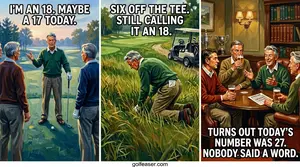
I Called Myself an 18. The Round Called Me a 26.
Every group has a guy who announces his handicap on the first tee. The comic strip about what the back nine actually reveals — and why nobody says a word.
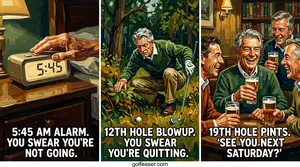
The 5:45 Alarm, the 12th-Hole Blowup, and the Pints After
Every weekend golfer knows this exact loop — the alarm you almost ignore, the blowup that makes you swear off golf, and the pints that undo it by dark.
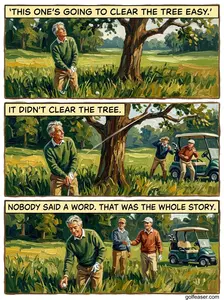
The Recovery Shot I Was Already Bragging About
He was already telling the story before he swung. Then the branch took it back — and why the silence that followed said more than a laugh ever could.

Johnny is a 25-year weekend golfer who's double-booked tee times, forgotten his clubs an hour from the course, and made pretty much every other trip-planning mistake there is — so you don't have to. Guided by The Golfeaser Manifesto, he started Golfeaser.com to prove that weekend golfers are a special, funnier breed who improve the experience, not just the scorecard. He's also the guy behind The Weekend Golfer's Social Playbook — a three-step system for finding your people, running trips that actually come together, and earning the right to brag at the 19th hole.
