- Home
- Tested by a Bogey Golfer
- Testing Equipment as an Average Golfer
- Push Cart vs. Carry vs. Cart
Push Cart, Carry Bag, or Riding Cart: The Honest Verdict From a Bogey Golfer
How many rounds does it actually take before you admit the bag on your shoulder is the reason your back feels like it does on Sunday morning?
Three summers ago I carried my bag through a muni that had exactly one flat lie on the entire back nine. By hole 16 I wasn't reading the green — I was doing math on how far it was to the cart barn and whether my second shot could just end the suffering a little sooner. Nobody in my group noticed. I noticed. That's usually how it goes with this stuff — you don't decide to switch equipment, your body decides for you and you spend a few more rounds ignoring it out of stubbornness.
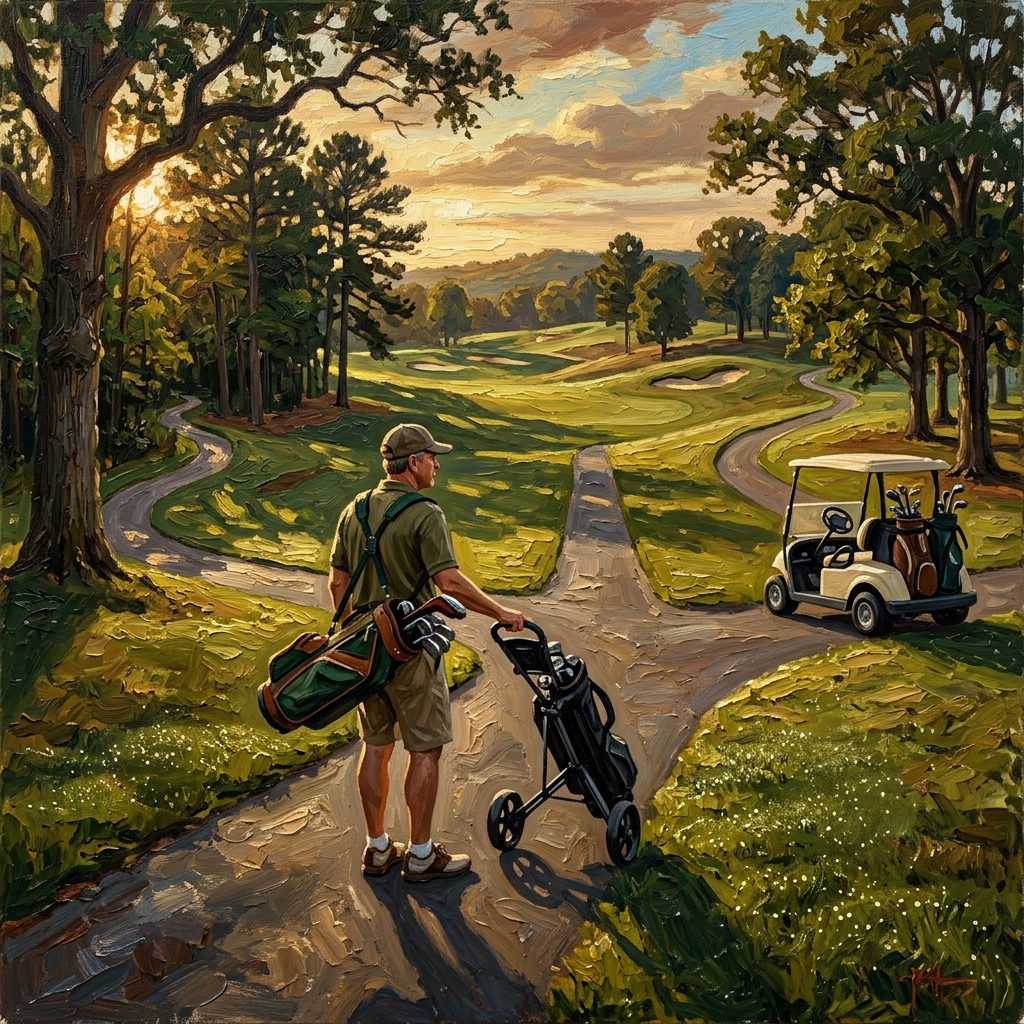
The fork in the path never asks which one you brought — it just asks how your knees feel by 16.
A push cart is the right call for most bogey golfers. It saves the shoulders and knees that a full bag wears down over 18 holes, it's a few hundred dollars once instead of a rental fee every round, and it doesn't leave you stranded on a cart path hunting a ball that's 40 yards off line. Carry your bag when you're playing nine holes, a short flat course, or you genuinely want the workout. Ride a cart when time, heat, terrain, or your body has given you a real reason — not just because it's what the starter handed you.
That's the short version. The long version is that "which one should I use" isn't really one question — it's four or five smaller ones about your body, your course, your wallet, and your group, and they don't all point the same direction every Saturday. It's the same honest-math approach behind everything in the Tested by a Bogey Golfer series, and the same one I used working out what clubs I actually needed in the first place. Improving my own experience out here has never meant owning the fanciest gear. It's meant paying attention to which piece of equipment actually gets out of the way so I can enjoy the round instead of surviving it.
What's the Real Difference Between These Three Options?
What actually separates a push cart, a carry bag, and a riding cart? Mostly three things: how much weight your body handles, how much walking you do, and how much money leaves your pocket and when.
Carrying puts the full weight of your clubs, balls, rangefinder, rain gear, and the granola bar you forgot about since March directly on your shoulder or your back, for every step of every hole. A push cart takes that same weight off your body entirely — you're still walking the course, but you're steering fifteen pounds of aluminum instead of hauling it. A riding cart removes the walking too, cutting your total distance down to the trips between cart and ball.
And that distance is bigger than most people assume. A widely cited study at Royal County Down found golfers walked an average of 6.6 miles over 18 holes — 69% more than the scorecard yardage alone — and a separate multi-year survey of over a thousand rounds put the overkill closer to 77% (Golf Monthly). On a typical 6,000-yard course, that works out to something like 12,000+ steps before you've even hit the 19th hole. If your only exercise this week is going to be the round on Saturday, that number matters.
It also matters for the fitness argument people make for carrying. A Center for Health and Sport Science experiment cited by the New York Times found walking while carrying burns roughly 1,400 calories over 18 holes — and walking with a push cart burns "a similar amount, albeit a fraction less." Riding, by comparison, lands closer to 800–1,300 calories, since you're still walking to raised tee boxes and swinging clubs, just not covering the whole course on foot (GOLF.com). Translation: if you're carrying purely for the workout, a push cart gets you almost all of it without the shoulder tax.
What Carrying Your Bag Actually Feels Like by the Back Nine
Carrying feels free at the first tee. No rental fee, no cart to load, nothing to steer around a tight dogleg. You sling the strap over your shoulder, feel strong for about six holes, and figure you've got this.
Then hole 10 shows up. The strap that felt fine at 9:15 has found the exact groove in your shoulder where it wants to live for the rest of the day. I've had rounds where I could tell you, without looking at a scorecard, exactly which hole my form started falling apart — because that's the hole where I stopped thinking about my swing and started thinking about how much farther the walk to 18 was. My scores on the back nine of carried rounds are, without fail, worse than my front nine. Not because I got worse at golf. Because I got tired, and tired golfers make worse decisions.
Here's the thing nobody talks about with carrying: the cost isn't measured in dollars, it's measured in attention. Every ounce of energy your body spends hauling clubs is energy it's not spending on your setup, your tempo, or noticing that the pin is actually back-left instead of front-right. Carrying "for free" quietly charges you a fee anyway — it just bills you in strokes instead of cash. That's not a reason to never carry. A short, flat nine-hole loop after work is a genuinely great use of a carry bag — light, quick, no gear to wrangle. But pretending an 18-hole carried round on a hilly course costs you nothing isn't improving your experience, it's just ignoring the bill until you're signing the scorecard. I found something similar the year I tried walking instead of riding for an entire season — the walking itself was never the actual problem. It was always the weight on my shoulder, and once I separated those two things the whole decision got a lot clearer.
The Push Cart Nobody Warns You About
Dave rolled up to the first tee last spring with a three-wheeled push cart and spent the entire round apologizing for how good his back felt. Nobody had asked him about his back. He brought it up on 4, again on 9, and once more walking off 18 — not bragging exactly, more like a guy who genuinely couldn't believe how much of a difference one piece of aluminum had made.
What nobody tells you before you buy one is how quickly a push cart disappears into the background of your round. You stop thinking about it almost immediately — you just steer with one hand while you talk, brake it on the downhills without thinking, and forget it's even doing work until you catch yourself standing over a putt with genuinely fresh legs on hole 17. A decent folding manual push cart runs somewhere between $80 and $200, folds down small enough for most trunks, and needs zero maintenance beyond the occasional tire check. Electric push carts — the kind that motor themselves up hills while you just steer — run $400 to $1,000-plus, and on a genuinely hilly course they're worth every dollar to anyone who's ever stood at the bottom of a par-3 tee box already dreading the walk back up.
The honest downsides: it's one more thing to load and unload from the trunk, it doesn't fit in every car (check before you buy, not after), and on courses that go cart-path-only during wet stretches, you're doing more walking than the riding-cart guys, not less — which is worth knowing before you assume a push cart always means the easy day. It's the same quiet payoff I noticed the first time I tried a rangefinder as a bogey golfer — the gear itself doesn't fix your golf, it just clears away one more thing standing between you and actually enjoying the round.
Riding the Cart: When It's the Right Call, Not the Lazy One
There's a strange guilt attached to riding a cart that carrying and pushing don't carry. Some corner of the golf world still treats it like admitting you couldn't handle the real version of the game. I've felt that guilt myself, usually right before climbing into a cart on a 98-degree July afternoon and immediately feeling like the smartest person in the foursome.
The round that changed my mind on this wasn't dramatic. It was just hot — heat-advisory hot, the kind where the starter was handing out extra water bottles at the first tee. My usual group walks. That day, three of us rode and one guy insisted on pushing his cart the whole way out of principle. He finished the round fine. He also spent the back nine noticeably quieter than usual, and by the 19th hole he admitted the heat had "gotten into his swing" somewhere around 14. Nobody needed to prove anything that day. The cart wasn't a shortcut — it was the difference between a group that stayed sharp through 18 and one guy who spent the last four holes just trying to finish.
Riding earns its keep in specific, real situations: brutal heat, a genuinely hilly or spread-out course, a body that's dealing with something — a bad knee, a recovering back, a joint that just doesn't do 6 miles anymore — or a tee time squeezed into a lunch break where walking simply isn't going to fit in the time available. None of that is lazy. It's the same logic anyone easing into senior golf figures out fast: the game doesn't get worse when you stop fighting your own body, it gets more fun. Making my foursome better sometimes means being the guy who rode so I had the energy left to actually be good company at the turn, instead of the guy dragging through the back nine and snapping at people because I'm gassed.
Push Cart vs. Carry Bag: Which One Actually Wins for Your Body?
Line them up honestly. Push cart: zero weight on your shoulders or spine, full walking distance retained (so the exercise argument for carrying mostly evaporates), one-time cost, one more item to store and load. Carry bag: full weight on your body for every step of every hole, same walking distance, zero extra gear, but a real physical bill that gets steeper as the round and the season go on.
For anyone playing 18 holes more than a handful of times a month, a push cart is close to a no-brainer on pure body math — you keep essentially all the walking-based fitness benefit and lose almost all the wear and tear. Carrying still has a real place: quick nine-hole rounds, minimalist walkers who genuinely prefer the feel of the bag on their back, courses where a cart genuinely can't navigate the terrain, or golfers who just haven't accumulated enough rounds yet to feel the cumulative cost. But "I've always carried" isn't a reason on its own once your shoulder starts disagreeing with you by hole 12 every single week. It's the same math I ran quitting premium balls for six months and playing 18 holes without a driver — most equipment decisions come down to what you're actually losing versus what you only assume you're losing.
🎯 Push Cart vs. Carry: The Real Tradeoffs
- ⭐ Push cart removes the weight — carrying removes nothing but your excuse to skip the gym
- 💰 Push cart costs $80–$300 once; carrying costs whatever your chiropractor charges by August
- 🔧 A folding push cart fits in most trunks; a carry bag fits in literally any car
- ✅ Push cart wins for anyone playing 18 holes more than a few times a month
- 🚫 Don't carry a full bag up a hilly course just to prove a point — nobody's impressed, including you
Push Cart vs. Riding Cart: Which One Wins for Your Score and Your Wallet?
The wallet math is the least debatable part of this whole comparison. A cart rental runs somewhere between $15 and $40 a round depending on the course, sometimes bundled into the green fee, sometimes not. Play twice a month and that's $360 to $960 a year, every year, forever. A manual push cart is a single purchase that, at $150 average, pays for itself inside a single golf season for anyone playing regularly — and then it's free for every round after that.
The score and pace math is murkier, and I'll be honest instead of pretending there's a clean answer. Walking with a push cart puts you in your own rhythm — you set the pace, you're moving between shots instead of waiting on a cart partner, and for a lot of bogey golfers that steadier tempo actually helps their swing more than it hurts their legs. Riding can speed up pace of play on long, spread-out courses where the next tee box is genuinely far from the previous green — but it can just as easily slow you down on tighter courses where you're constantly parking, walking to your ball, walking back, and re-parking. Cart-path-only days erase most of riding's convenience anyway, since you end up walking nearly as far as the push cart crowd while still paying the rental fee.
If you play regularly and your body allows it, a push cart wins on cost every single season and roughly ties on pace depending on the course. Riding wins when time is the actual constraint, when the course genuinely rewards it, or when your body needs the break that day. Neither one makes you a worse or better golfer — they just solve different problems. It's the same one-time-versus-forever math that shows up everywhere in a bogey golfer's bag, from a GPS watch versus your phone to figuring out how many balls you actually need to carry before the pro shop starts feeling like a subscription service.
Terrain, Weather, and the Course You Actually Play
Some of this decision isn't about you at all — it's about where you're playing.
Hilly or mountain courses favor riding, or at minimum an electric push cart that motors itself uphill while you steer. Flat munis and short executive courses are where a manual push cart or a carry bag genuinely shine, since there's no terrain punishing your legs for choosing to walk. Hot-weather rounds lean toward riding for straightforward heat-safety reasons — dehydration doesn't care how tough you feel on the first tee. Rain rounds keep your bag and your clubs drier in a cart with a canopy than exposed on a push cart, though a decent rain cover closes most of that gap. And cart-path-only days are worth checking before you assume riding means an easy day — on a spread-out course, path-only can mean you're walking nearly the full distance anyway, just with extra detours to and from the cart.
Course conditions matter too, and this is the part push cart owners find out the hard way. Soft ground after rain, sandy waste areas, and thick wet rough can all bog down a manual push cart's front wheel in a way that turns a quiet round into a wrestling match. Some of the nicer daily-fee courses actually rope off wet fairways specifically to keep push carts off them, which — annoying as it is in the moment — usually means the superintendent is protecting the exact turf you'd be chewing up. Check the cart sign at the first tee before you assume yesterday's rain didn't change anything.
What Your Group Thinks When You Show Up With Each One
Equipment choices carry a weird amount of social weight in a regular foursome, whether anyone admits it or not. The guy who always rides gets the occasional "must be nice" comment, even when his knees have earned it fair and square. The guy who insists on carrying every single round, hilly course or not, ends up holding up the group by 15 without meaning to — and Mike, in my group, has asked more than once why I "torture myself" walking a full bag up the back nine at our home course when I own a perfectly good push cart sitting in the garage.
What actually matters to the group isn't which equipment you brought — it's whether you're still present by hole 16. A gassed carrier who's gone quiet and slow is worse company than a rider who's fresh and talkative. A push cart splits the difference well enough that it rarely becomes a group issue at all — you're walking with everyone, moving at pace, and not visibly suffering. Making your foursome better sometimes just means picking the option that keeps you engaged instead of surviving, whatever that ends up being that particular Saturday.
Which One Should You Actually Get? (The Decision, Broken Down)
Strip away the preferences and traditions, and the choice mostly comes down to three honest questions: does your body have a real limitation, do you play often enough for a purchase to make sense, and what does your usual course actually demand. It's the same kind of blunt math I used the day I got fit for clubs as a 20-handicapper — most gear questions get a lot simpler once you stop asking what the pros use and start asking what your actual game needs.
What Actually Changed When I Stopped Carrying
📋 What Actually Happened When I Tried All Three
- 😤 Before: carrying a full bag every round, gassed by 15, going quiet and snapping about pace on the back nine
- 💡 The experiment: a manual push cart for a full season, riding only on true heat-advisory days
- 🎯 What changed: real energy left for the back nine, noticeably steadier short game late in the round, and about $150 spent once instead of a rental fee every single time out
- 🏌️ The verdict: push cart is the default now. I ride when the weather or my body actually asks for it, and I still carry for a quick nine after work.
I'm not totally sure why the back nine improvement surprised me as much as it did — it's not complicated, tired golfers play worse golf — but there's a difference between knowing that and actually feeling it show up on the scorecard for months in a row. Something happened. Something changed. Mostly it was just that I stopped spending a third of every round negotiating with my own shoulder.
🏌️ Got a Golf Story?
Share it with us. Every story we publish earns the author a free copy of The Weekend Golfer's Social Playbook — our three-step system for finding your people, running trips that actually come together, and earning the right to brag at the 19th hole.
Or join the Golfeasers — free weekly content for people like us.
Your Push Cart, Carry Bag, and Cart Questions, Answered
Can I use a push cart at every golf course? Most public courses and munis allow push carts without any issue, but some private clubs restrict them during member events or tournament play, and a small number of upscale courses require riding carts only to protect the turf. Call ahead or check the course website before you show up with one for the first time.
Are electric push carts worth the extra money? If your home course is genuinely hilly or you're dealing with any joint issue, yes — the self-propelled hill climb is the whole point and it's worth the $400-plus jump from a manual cart. If you mostly play flat courses, a manual push cart does the same core job for a fraction of the price and there's nothing to charge before your round.
Is carrying your bag actually better exercise than a push cart? Barely, and not enough to matter. Research on calorie burn during a round found carrying and pushing land within a "fraction" of each other, while riding trails both by a meaningful margin. If fitness is your real goal, a push cart gets you nearly all of it without the shoulder wear.
What should I do if my regular group always rides and I'd rather push? Say so. A group that's worth playing with every week can handle one guy walking while the others ride — plenty of foursomes mix it without anyone thinking twice. The only real rule is not making the group wait on you, whichever option you pick.
How much should I actually expect to spend on a decent push cart? A solid manual push cart lands somewhere between $80 and $200, and at that price it's built to last years, not one season. Electric push carts start around $400 and climb past $1,000 for the models with app controls and GPS mapping — features that are genuinely nice but not what makes the cart worth buying. The hill-climbing motor is the feature; everything else is a bonus you'll use maybe twice a season.
Keep Reading Before Your Next Round
Curious what your other numbers actually look like beyond how tired your legs are? See what a real 20-handicap's stats actually look like. If the walking-versus-riding question has you thinking about strategy too, here's how to play smart when you're not playing well. Shopping for someone who's dealing with the same knees and hills — just further along than you? senior golf equipment that actually helps covers the gear side of that conversation. And if the putter's next on your equipment list, mallet vs. blade putter for a high handicapper is the natural next test.

Johnny is a 25-year weekend golfer who's double-booked tee times, forgotten his clubs an hour from the course, and made pretty much every other trip-planning mistake there is — so you don't have to. Guided by The Golfeaser Manifesto, he started Golfeaser.com to prove that weekend golfers are a special, funnier breed who improve the experience, not just the scorecard. He's also the guy behind The Weekend Golfer's Social Playbook — a three-step system for finding your people, running trips that actually come together, and earning the right to brag at the 19th hole.
