- Home
- Tested by a Bogey Golfer
- Testing Training Aids
- DIY Golf Training Aids That Actually Work
I Built Five Golf Training Aids in My Garage for Under $20. Here's the Honest Verdict
Mike asked me why there was a pillowcase stuffed with towels sitting on my back seat next to my golf bag.
I told him it was an impact bag. He asked how much I paid for it. I told him I paid nothing, because it was a pillowcase from the linen closet and two towels my wife had already earmarked for the donation pile. He looked at it for a second, looked at the $45 impact bag on the shelf at the golf store the next time we were there together, and said, "Huh." That's the whole review, honestly, but I'll give you the longer version.
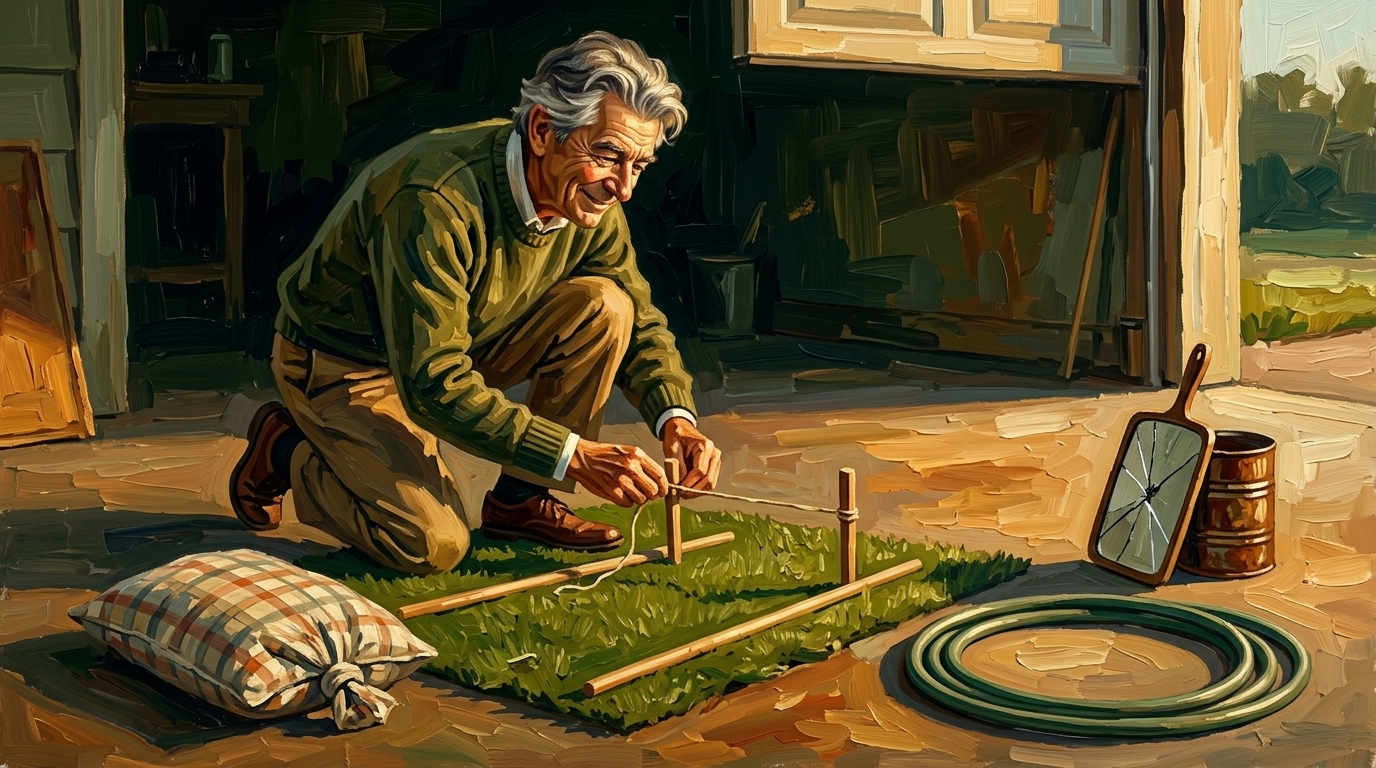
I'm not totally sure which neighbor saw me tying string between two stakes in the front yard, but nobody's asked yet, and the gate drill is still up.
Most DIY golf training aids work close to as well as the store-bought version, because a lot of what's sold as a "training aid" is a simple idea wrapped in $30 of plastic and a logo. I built five of them over one long weekend — an impact bag, an alignment gate, a putting mirror, a swing-plane guide, and a tempo cue — for under $20 total, and three of them are now a permanent part of my range routine.
Here's the thing nobody talks about with training aids: the aid isn't really the product. The repetition is the product. A $40 alignment stick set and two paint stir sticks from the hardware store do the exact same job of showing you where your feet and shoulders are actually pointed — which, if you've ever set up dead square and still pushed one thirty yards right, you already know isn't nothing. I'm not trying to save you money as a personality trait here. I just noticed I was about to spend $120 on four separate training aids and had almost everything I needed already sitting in a drawer, a closet, or the garage. That's improving my own experience without waiting for a gear catalog to tell me how.
What's Actually in the Garage for This
Before the individual verdicts, here's what these five are built from. This isn't a hypothetical "you could probably build this" list — I built all five out of stuff I already had lying around, and this is the actual materials list.
🔧 What Five Garage Training Aids Are Made From
- ✅ Impact bag: an old pillowcase and two towels headed for the donation pile
- 💡 Alignment gate: two paint stir sticks and a length of kitchen string
- ⭐ Putting mirror: a dollar-store hand mirror and a rubber band
- 🔧 Swing-plane guide: a garden hose already coiled in the shed
- ⛳ Tempo cue: nothing but your own voice, counting "one-Mississippi-two" — and yes, I felt ridiculous saying that out loud on a public range
Total build time for all five, working at a normal weekend pace and not rushing: about ninety minutes, most of which was spent looking for the second towel. Compare that to the four aids I'd been eyeing individually in my running series testing training aids — I'm not saying never buy a training aid, since the tempo trainer I tested against a real lesson is a genuinely well-made piece of plastic that does one job precisely. I'm saying check the garage first, and the actual dollar breakdown against each store-bought version is below, once you've seen how each one performed.
The Impact Bag That's Just a Pillowcase
I stuffed an old pillowcase with two bath towels, knotted the open end tight, and set it on the practice mat where the ball would normally sit. First swing, I hit it half-hearted, the way you'd hit a pillow you're annoyed at, and it barely moved. Second swing, full speed, and I felt exactly what a $45 impact bag is selling you: the jolt through my hands and forearms that tells you whether your wrists were leading the clubhead through impact or flipping past it.
Mine were flipping. Had been for who knows how long. Twenty swings into the bag and my right wrist genuinely hurt — good hurt, the kind that tells you a joint has been doing a job your body wasn't built to let it do. I eased off the towel density after that, because a stuffed pillowcase doesn't have a padding rating and there's no reason to find out the hard way. The impact tape I tested separately tells you where on the face you struck it; the pillowcase tells you what your body was doing when you got there. They're answering two different questions, and using both together taught me more in one range session than either one alone.
The verdict: keep it. It's ugly, it lives in my trunk next to a bag of tees, and it's the single aid out of all five I'd tell a buddy to build tonight if he's dealing with a slice he can't explain.
Does a $3 Alignment Gate Beat $25 Store-Bought Sticks?
Mostly yes, with one real trade-off. Two paint stir sticks pushed into the ground at your target line, spaced just wider than your clubhead, do the identical job that a pair of $25 branded alignment sticks do — they show you, brutally, whether your swing path is coming from inside or outside where it should be, because you'll clip a stick if it isn't.
The trade-off is durability and portability. The real alignment sticks I tested for a month fold down, travel in a bag sleeve, and survive being run over by a golf cart, which happened once and which the paint stir sticks would not have survived. If you're building a home setup that lives in one spot — a mat in the garage, a corner of the backyard — the stir sticks are functionally identical for a tenth of the price. If you want something that rides in your car and goes to the actual range with you, buy the real ones once and be done with it.
I used the DIY gate for three weeks before I trusted it enough to stop double-checking my alignment with a phone camera. That's the actual test of any alignment tool, homemade or not: does it eventually make itself unnecessary because you've internalized what square feels like. Mine did, right around the point my buddy Jim stopped saying "aim more left" on the first tee, which had become something close to a standing joke by then.
The Putting Mirror That's Just a Mirror
Store-bought putting mirrors and a dollar-store hand mirror with a rubber band do exactly the same optical trick: they let you see your eye position over the ball and check whether your putter face is square at address, because a mirror doesn't lie about angles the way your own sense of "that looks straight" absolutely does.
The purpose-built putting mirror I tested has one real advantage — it's flat and etched with alignment lines, so you're not fighting the slight curve of a cheap hand mirror. I noticed the curve on mine within the first ten putts; it wasn't enough to throw off the face-angle check, but it was enough that I wouldn't trust it for the eye-position check without also gut-checking against a wall mirror at home first.
Here's the pick, honestly, and it's close: if you're checking putter face angle at setup, the $4 hand mirror does the job. If you're serious about diagnosing your full putting stroke — eye line, ball position, the works — spend the $20-something on the real thing, because the flat surface and etched lines remove one variable you don't want to be second-guessing on the green.
The Swing-Plane Guide Made From a Garden Hose
Coil a garden hose into a rough circle on the ground, angled to roughly match your swing plane, and you've got a visual guide for whether your club is tracking on-plane through the backswing without spending anything at all. It's not precise. It's not going to catch a two-degree deviation. What it does catch is the big, obvious stuff — the club getting laid off way inside, or yanked way outside — the kind of error you can actually feel and fix once you see it happening in real time next to a hose instead of only in a slow-motion phone video after the fact.
I used this one for maybe four range sessions and then stopped, not because it failed, but because once I'd corrected the big miss, the hose stopped teaching me anything new. That's fine. Not every training aid needs to be a permanent fixture — some exist to fix one specific thing and then get put away, and there's no shame in that.
Tempo: The One "Aid" That Costs Nothing At All
Every tempo trainer on the market — including the $30 one I bought and tested against a real lesson — is selling you a consistent backswing-to-downswing ratio, roughly three-to-one, delivered through a beep or a click. Counting "one-Mississippi-two" under your breath on the backswing and through impact does the same job for free, and I felt genuinely silly saying it out loud the first few times on a crowded range.
My tempo has always been the thing that falls apart when I'm rushing — first tee nerves, a group waiting behind us, whatever it is. Ten minutes of counting out loud on the range didn't fix that instantly. What it did was give me something to fall back on mid-round, on the tee box, without needing a device clipped to my glove. I used it on the back nine two Saturdays ago after a particularly ugly front nine, said the count quietly to myself before three consecutive tee shots, and hit all three in the fairway. Could be luck, but my guess is it was the count doing exactly what a $30 device would have done for exactly zero dollars.
If you want the actual data — the beep, the readout, proof your ratio is drifting — the real tempo trainer earns its money. If you just need a mental anchor when things start speeding up, you already own the only equipment required.
The One I Tried and Ditched: The Coin-Gate Putting Drill
Not everything on this list worked, and the honest version of this article has to include the failure. I set two coins on the green about a putter-head width apart, just outside the toe and heel at address, the way half the putting-drill videos online tell you to. The idea is that a square stroke threads the gate cleanly and an open or shut face clips a coin on the way through.
Two putts in, I clipped a coin on a putt that rolled dead center into the cup. The gate was punishing my stroke path for something that had nothing to do with whether the ball went in, which is a different measurement than the one I actually cared about. I widened the gate, then widened it again, and by the third adjustment I was basically just putting at two coins that weren't doing anything.
My buddy Dave, who golfs with a level of confidence his handicap doesn't fully support, said quitting a drill after one bad session doesn't prove anything. He's not wrong as a general rule — I gave the impact bag three sessions before I trusted it. But the coin gate wasn't giving me bad feedback slowly; it was giving me feedback that didn't map to the thing I was trying to fix, and no amount of extra sessions changes that. If a drill is measuring the wrong thing precisely, more reps just make you precisely wrong for longer. I've since put the coins back in the cupholder where they belong. If a homemade drill keeps giving you feedback that doesn't match the actual problem, that's usually the point where a real lesson earns its cost faster than another week of guessing — a second set of eyes catches in one look what I spent three putts arguing with two coins about.
What My Buddies Actually Said When They Saw This Stuff
Jim's first reaction to the garden hose swing-plane guide was to ask if I'd lost a bet. Dave wanted to know if the pillowcase was going to end up smelling like the driving range mat, which, fair question, it kind of does now. None of it was mean — it's the same ribbing anyone in a regular Saturday group gets for showing up with something new, and honestly it's part of why I keep bringing this stuff out instead of quietly practicing alone.
Here's what actually shifted the mood: it wasn't the gear, it was that I got noticeably better at knowing where my clubface was at impact within about three weeks, and that showed up in fewer balls sprayed into the trees on the right. Once Jim saw two tee shots in a row split the fairway that used to leak right, the "lost a bet" jokes turned into "wait, show me the stick thing again." That's basically the whole premise behind everything I test for this corner of the site — not chasing a lower handicap for its own sake, but bringing something back to the group that actually holds up when someone else tries it.
What I'd Actually Build Again
📋 What Actually Happened When I Tested Five DIY Training Aids
- 😤 Before: About to spend $120 on four separate training aids without checking what I already owned
- 💡 The experiment: Built five DIY versions — impact bag, alignment gate, putting mirror, swing-plane guide, tempo cue — over one weekend, used each for at least three range sessions
- 🎯 What changed: Three of the five stayed in permanent rotation; two solved a specific problem and then got retired, which is a fine outcome for a training aid
- 🏌️ The verdict: Build the impact bag and the alignment gate first — they're free-to-cheap and they're doing real work; buy the real tempo trainer only if you want the data, not just the cue
Three range sessions in, I could already sort these into two piles, and the sorting itself turned out to be the useful part. Everything I've tested and ranked so far follows the same pattern: the cheap, dumb, obvious fix usually beats the expensive, elegant one, because the expensive one is often solving a problem you don't actually have.
I make no claims about being good at golf, and this experiment didn't fix my handicap. What it did was make my Saturday range time slightly more useful than it was the weekend before, which is the entire, modest goal. That's the whole thing that makes my foursome better at this — not a swing overhaul, just showing up marginally more dialed in than the guy who bought four gadgets and used none of them twice.
Can You Use These During an Actual Round?
No, not the training aids themselves — Rule 4.3 of the Rules of Golf restricts using an artificial device or unusual piece of equipment to help you make a stroke during a stipulated round, which covers a store-bought impact bag exactly the same way it covers a stuffed pillowcase. The plain-English breakdown of the rule is worth a read if you've ever wondered why nobody sets up an alignment gate on the first tee.
What you can absolutely carry over is the habit the aid taught you — the tempo count, the feeling of a square setup from the gate drill, the wrist position the impact bag drilled into your hands. The aid stays in the garage. The muscle memory rides in the cart with you, which was the point all along.
The Five-Minute Version, If You're Skimming
⛳ The Honest Shopping List
- ✅ Build first: the impact bag (pillowcase + towels) and the alignment gate (two stir sticks) — both are near-free and both taught me something real
- 💡 Build for the price, buy for the road: the alignment gate stays home; the real sticks travel with you
- 🚫 Don't over-invest in the mirror: a dollar-store hand mirror covers face-angle checks fine, skip the upgrade unless you're diagnosing your full stroke
- ⭐ Free forever: counting your tempo out loud costs nothing and does most of what a $30 device does
The bigger takeaway than any single aid: check what's already in the garage, the linen closet, and the shed before the next training-aid ad convinces you that you're missing a $40 piece of plastic. A lot of golf improvement at our level is just repetition with decent feedback, and decent feedback is cheaper than the industry wants you to believe. If you'd rather skip the DIY route entirely and go straight to what's actually worth buying, the full training aids hub has every honest test I've run so far. A pillowcase full of old towels will never look as good under the tree as a wrapped box from the pro shop, though — for that side of the equation, the stocking-stuffer guide covers the cheap store-bought stuff that's actually worth gifting.
🏌️ Got a Golf Story?
Share it with us. Every story we publish earns the author a free copy of The Weekend Golfer's Social Playbook — our three-step system for finding your people, running trips that actually come together, and earning the right to brag at the 19th hole.
Or join the Golfeasers — free weekly content for people like us.
More Honest Tests From the Bag
If you liked the receipts on this one, these go deeper on the same question of what's actually worth your money at our level:
- What Clubs Do You Actually Need? The Minimalist Bogey Bag
- I Used a Rangefinder for the First Time as a Bogey Golfer
- Push Cart vs. Carry vs. Riding Cart: What a Bogey Golfer Actually Needs
- What a Real 20-Handicap's Stats Actually Look Like
Quick Answers Before You Raid Your Garage
Are DIY golf training aids actually as effective as store-bought ones? For the basics — alignment, impact feedback, tempo — mostly yes. The physics of a pillowcase impact bag or a pair of stir sticks in the ground is identical to the branded version; you're paying extra for durability, portability, and a nicer finish, not a different result.
What's the cheapest training aid that actually works? The impact bag. It costs nothing if you've got an old pillowcase and two towels you were going to donate anyway, and it gives you immediate, physical feedback on wrist position at impact that's hard to get any other way without a coach standing next to you.
Do I need real tools or a workshop to build these? No. Everything in this test came together with things already in a linen closet, a junk drawer, or a garage shelf — string, stir sticks, a hand mirror, a garden hose. The most advanced tool involved was a pair of scissors.
How long should I use one before deciding if it's working? Give it three range sessions minimum before judging. The alignment gate and the impact bag both took a session or two before I trusted what they were telling me over my own sense of "that felt fine."
Which one should a total beginner start with? The impact bag. It's the one aid on this list that doesn't require you to already know what "on-plane" or "square" feels like — it just tells you, honestly and immediately, what your hands were doing when the club got there.

Johnny is a 25-year weekend golfer who's double-booked tee times, forgotten his clubs an hour from the course, and made pretty much every other trip-planning mistake there is — so you don't have to. Guided by The Golfeaser Manifesto, he started Golfeaser.com to prove that weekend golfers are a special, funnier breed who improve the experience, not just the scorecard. He's also the guy behind The Weekend Golfer's Social Playbook — a three-step system for finding your people, running trips that actually come together, and earning the right to brag at the 19th hole.
