- Home
- Tested by a Bogey Golfer
- Testing Training Aids
- The Putting Mirror Test
The Putting Mirror: Does It Actually Fix Anything?
I have owned a putting mirror for three years. I used it twice — once the day I bought it, once about six months later when I found it wedged under a rain jacket in my trunk and felt guilty enough to give it another shot. Then it went back in a drawer in the garage, next to a chipping net I've used four times and a swing trainer I've used never.
I am not a training-aid guy. I buy the aid after a bad Saturday, use it hard for eleven days, then quietly stop. Every golfer with a garage full of unopened boxes knows this pattern. Improving my own experience out here — the whole point of the Golfeaser Manifesto — has never come from a gadget, it's come from paying attention. But $14 felt like a low enough bet to take seriously, so this spring I gave it a real month, same as everything else in the Tested by a Bogey Golfer series.
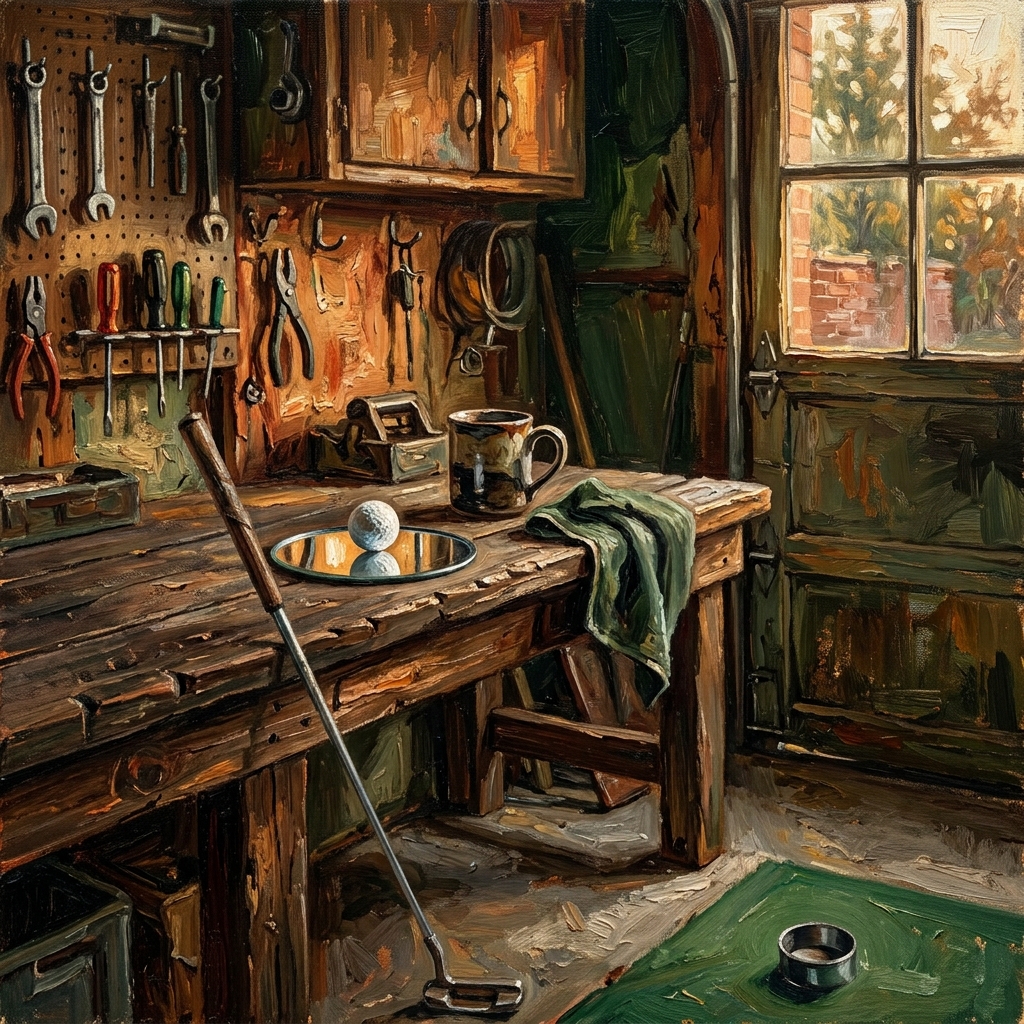
Kinda like a smoke detector — you forget it's there for three years, right up until the week it actually tells you something.
A putting mirror won't fix a broken stroke, and it won't teach you to read a green. What it does is show you, in real time, exactly where your eyes and your putter face sit at address — which for a lot of bogey golfers is the actual source of the miss they keep blaming on "just not making anything lately." After a full month of using mine, my alignment got noticeably more consistent. My putts per round barely moved. Both of those things are true, and neither one is the whole story.
What a Putting Mirror Is Actually Supposed to Do
What's a putting mirror, exactly? It's a flat, reflective disc or mat — usually 8 to 12 inches across — with a printed alignment line or gate running through the middle. You set your ball on the marked spot, take your stance over it, and look down. If your eyes are directly over the ball (or just inside it, depending on whose method you follow), you'll see a clean, undoubled reflection. If they're not, you'll see two of yourself staring back, which is a genuinely strange thing to notice about your own putting stance for the first time at 41 years old.
Why would that matter? Because your eye line determines how square your read looks, and a putter face that looks square from a bad eye position isn't actually square. The pitch on every box is some version of "perfect alignment, guaranteed" — which oversells what a static mirror can do. It's not lying, exactly. It's just describing the setup, not the stroke, and the stroke is where most three-putts actually happen.
I'd tried alignment sticks for the same problem a few months back — laid flat on the ground, they show you your target line, but they don't touch eye position or face angle the way a mirror does. Different tool, different half of the same problem — which is part of why I keep working through the whole testing training aids pile one cheap product at a time instead of assuming any single one does everything.
The Mistake Almost Everyone Makes With One
Most guys who buy a putting mirror make the same error I did the first two times: they look down once, decide their setup is fine, and put it away. A single glance tells you almost nothing, because your brain is very good at compensating in the moment and forgetting the compensation ever happened.
The mistake compounds a second way, too. A lot of golfers set the mirror up, get their eyes and face lined up perfectly — and then never actually hit a putt from that position. They treat it like a photo op instead of a rehearsal tool. The whole point is building the feel of the correct setup into your hands so it shows up on the course without a mirror in front of you. Standing over it and admiring good alignment for ten seconds doesn't do that; hitting fifteen putts in a row from that exact position does.
There's a third version I didn't expect: guys who use it exclusively at home on carpet and never once on an actual green. Carpet doesn't roll true, so it won't tell you anything about speed — fine, that's not the mirror's job anyway — but it also flattens out your natural stance a little differently than a green does, especially if you've got any slope under your feet at your home course. If you only ever practice flat and indoors, don't be shocked when the first sloped green of the season makes your "fixed" setup feel foreign again. It's the same trap as impact tape — a diagnostic tool only tells you the truth if you actually put it in a real situation, not a convenient one.
Why Mine Sat in a Drawer for Three Years
I bought it the Monday after a Saturday where I three-putted four greens in a row at a course I actually know well. Not lipped out — three-putted, the kind where you leave the first one eight feet short and then miss the comebacker because you're rattled. Mike didn't say anything about it in the cart. He didn't have to. He just kept looking at his phone a beat too long every time I picked my ball out of the cup.
I ordered the mirror that night, used it in the living room for maybe ten minutes, decided my stroke looked "basically fine," and moved on with my life. Eleven days is generous for how long most of my training-aid enthusiasm lasts. This one didn't even make it a week before I told myself I already knew what it would show me.
The Actual Experiment: Four Sessions a Week, for a Month
Here's what changed: I finally admitted I didn't know what the mirror would show me, because I'd never actually watched myself use it. So I set a real rule — 20 minutes, four times a week, on the practice green at my club before my Tuesday and Thursday range sessions, plus two sessions at home on the living room carpet with a cup taped to the floor. Four weeks, no skipping, phone in the other room.
My baseline going in was rough but honest: I was averaging 34 putts a round over my last five rounds, with at least one three-putt in four of them. That's not far off what a real 20-handicap's stats actually look like, and it lines up with the general range for average putts per round for a bogey golfer — which was oddly reassuring, since it meant I wasn't dealing with some rare or exotic problem, just the standard one. I wrote both numbers on a sticky note on the mirror's box so I couldn't quietly revise my memory of how bad it was, which — full disclosure — is exactly the kind of thing I would otherwise do.
📋 What Actually Happened When I Tested the Putting Mirror
- 😤 Before: 34 putts a round average, three-putting at least once in most rounds, and no real idea whether my setup was the problem
- 💡 The experiment: 20 minutes, four sessions a week — two on the club practice green, two at home — for four straight weeks
- 🎯 What changed: Alignment got visibly more consistent and three-putts dropped noticeably; overall putts per round barely moved
- 🏌️ The verdict: Worth the $14 if your miss is alignment — not a fix if your real problem is speed or green reading
What the Mirror Actually Showed Me
Going in, I assumed two things about my own setup: that my eyes were roughly centered over the ball, and that my putter face looked square because it felt square. Neither one held up.
My eyes were sitting almost two inches inside the target line — close enough to normal that no playing partner would ever call it out, but far enough that I was reading every putt from a slightly rotated vantage point without knowing it. And the putter face, on maybe one in five looks, was closed a couple of degrees at address. Not dramatically. Just enough that "it felt square" turned out to mean nothing at all. I'm not totally sure why that gap between feel and reality is so wide — my guess is that once you've putted the same way for two decades, "correct" just means "familiar," whether or not it actually is.
Compare that to what alignment sticks told me back when I tried those: sticks are honest about your target line but silent about your eyes and your face angle. The mirror is the opposite — brutally honest about eye position and face angle, silent about tempo, speed, and where the putt actually breaks. You need both halves of the picture, and no single $14 tool gives you all of it.
Did My Putting Actually Get Better?
The honest answer is: partially, and not in the way I expected. Putts per round went from 34 to 33 over the next five rounds — a number small enough that it could be noise, weather, or a slightly better set of greens. Three-putts, though, dropped from four rounds out of five down to one. That's the number I actually trust, because a three-putt is almost always a setup-and-first-putt problem, and setup was the exact thing the mirror was working on.
That distinction is the whole verdict, honestly. A mirror can't shave a stroke off a lag putt from 40 feet — that's speed, and speed is a feel you build over hundreds of putts, not a setup you check once. But it can stop the setup mistake that turns one bad putt into two.
Where It Actually Helped
The alignment work stuck. Once I could feel what a genuinely centered eye position and a genuinely square face looked like, I started catching the closed-face habit before I even took the putter back — no mirror required, just muscle memory built from four weeks of actually seeing it. My pre-putt routine got shorter and more consistent, too, because I wasn't second-guessing my setup on every putt the way I used to.
It's also just cheap and portable in a way that matters. It rides in my bag now instead of a drawer, and ten minutes on the practice green before a round does more for my first putt of the day than any amount of standing there swinging my arms.
Where It Fell Short
It does exactly one job and stops there. Speed control, which is honestly the bigger source of three-putts for most 20-handicappers, isn't something a static mirror touches at all — that's why the number barely moved even as the blow-up holes disappeared. It also only checks your position at address, not anywhere in the actual stroke, so a golfer whose miss happens on the backswing or through impact won't get much from it.
And I'll be honest about the boredom factor: staring at your own reflection for 20 minutes, four times a week, is not a thrilling use of a Tuesday evening. By week three I was doing the sessions almost entirely because I'd committed to the sticky note, not because I was enjoying myself.
There's also a putter-type wrinkle nobody mentions on the box. I game a mallet, and the wider sightline across the top of a mallet head made the closed-face issue easier to spot in the mirror than I think it would've been with a blade — a buddy of mine with a blade putter tried mine for a session and said he genuinely couldn't tell the difference between "square" and "a couple degrees off" just by eye, even looking straight down at the mirror. Whether a mallet or a blade putter actually helps a bogey golfer read that difference is its own question, but it's worth knowing before you assume the mirror will work the same way for everyone in your group.
The Buddy Who Called It a Waste of Money
Dave saw it in my bag and asked what I was even trying to fix — his exact words were something like "you've putted the same way for twenty years, a mirror isn't going to change your brain." Fair objection. Grinding on eye position for twenty minutes on a Tuesday isn't going to win me any bragging rights at the 19th hole. Nobody's ever impressed by a good setup; they're impressed by a good result.
But that's also the point. I wasn't trying to change how I feel about putting — I was trying to find out if the thing I'd been doing on faith for two decades was actually correct. It wasn't, not entirely. Dave's right that habits built over twenty years are stubborn. He's wrong that stubborn means untouchable — it just means it takes a month instead of a weekend, and a lot of guys quit before they find that out. It's the same argument I had with myself testing a $30 tempo trainer against one real lesson — cheap and slow can still beat expensive and fast, if you actually stick with it.
Is It Worth the Money for a Bogey Golfer?
Yes — with a specific condition. If your misses cluster around bad first putts, weird lip-outs from short range, or a putter face that "feels" square but probably isn't, a $14 mirror is one of the cheapest, most honest diagnostic tools you can put in a golf bag. If your actual problem is distance control on 30-footers or reading break on your home course, save the money and spend the time on the practice green instead — no mirror fixes that.
I took one real lesson a couple of years back and it did more for my overall game in an hour than the mirror did in a month. But the mirror cost less than a sleeve of good balls and fixed the one specific thing it promised to fix. That's a rare enough thing from a $14 product that I'm not mad about the three years it spent in a drawer — I just wish I'd trusted it sooner, the same way I've had to admit with a few other things on the full list of what I've actually tested. Keeping the whole bag simple has helped, too — I stripped mine down to what a bogey golfer actually needs a while back, and a $14 mirror fits that philosophy better than half the gear I used to carry.
🔧 Getting the Most Out of a Putting Mirror
- ✅ Use it before you putt, not instead of putting — 5 minutes of real alignment checks beats 20 minutes of staring
- ⭐ Write your baseline putts-per-round down somewhere before you start — memory alone will let you off easy
- 🚫 Don't expect it to touch speed control or green reading — it only checks your setup, nothing after
- 💡 Pair it with actual practice green time — the mirror teaches the position, real putts teach the feel
You're always just one round away from the version of your putting that this actually sticks — mine just took a month and a sticky note to get there.
What a Month With a $14 Mirror Actually Taught Me
🎯 The Putting Mirror, Honestly
- ⭐ It fixes eye position and face angle at address — a real problem for a lot of bogey golfers, not an imaginary one
- 🎯 My putts per round barely changed, but three-putt rounds dropped from 4-in-5 to 1-in-5
- 🚫 It does nothing for speed control or reading greens — don't buy it expecting that
- 💰 At $14, it's cheap enough that the real cost is the four weeks of actually using it, not the money
🏌️ Got a Golf Story?
Share it with us. Every story we publish earns the author a free copy of The Weekend Golfer's Social Playbook — our three-step system for finding your people, running trips that actually come together, and earning the right to brag at the 19th hole.
Or join the Golfeasers — free weekly content for people like us.
Questions Other Bogey Golfers Ask About Putting Mirrors
Does a putting mirror actually improve your putting? It improves one specific part of it — eye position and putter face angle at address — which is a real and common source of missed putts. It won't touch speed control or your ability to read a break, so "improve your putting" depends entirely on what's actually broken.
How long before you see a difference? I noticed the setup awareness within the first week, but it took a full month of consistent use before it showed up as fewer three-putts on the course. Anyone promising results after a single session is overselling it.
Is a putting mirror the same as an alignment stick? No. Alignment sticks show your target line on the ground; a mirror shows your eye position and putter face angle when you look down at address. They fix different halves of the same setup problem, and using both tells you more than either one alone — I'd tried the sticks separately and they never caught the closed-face issue the mirror found.
Do pros actually use putting mirrors? Plenty do, especially as a pre-round or practice-session check rather than something they carry mid-round. The tool works the same way for a scratch player as it does for a 20-handicapper — it just has less to correct.
Is it worth buying over just taking a lesson? They're not really competing for the same job. A lesson diagnoses whatever's actually wrong with your stroke and can fix things a mirror never will; a mirror is a $14 way to make sure your setup isn't sabotaging you before you even take the club back. If you can only do one, the lesson wins — but the mirror is worth having either way.
More Cheap Training Aids Worth (or Not Worth) the Drawer Space
Testing this one led straight into a few related questions worth answering while I'm at it. If you've got your own pile of half-used gear, these cover the rest of the drawer:
- Alignment sticks, tested for a month — the ground-level version of the same fix
- I tried the viral swing tip for 30 days — the same honest-testing approach, applied to your full swing
- Playing smart when you're not playing well — course management for the days a mirror can't help
- What a real bogey golfer's putts per round actually look like — so you know if your baseline is normal
- Tempo trainer vs. one real lesson — which one actually moved the needle

Johnny is a 25-year weekend golfer who's double-booked tee times, forgotten his clubs an hour from the course, and made pretty much every other trip-planning mistake there is — so you don't have to. Guided by The Golfeaser Manifesto, he started Golfeaser.com to prove that weekend golfers are a special, funnier breed who improve the experience, not just the scorecard. He's also the guy behind The Weekend Golfer's Social Playbook — a three-step system for finding your people, running trips that actually come together, and earning the right to brag at the 19th hole.
