- Home
- Weekend Golfer Life
- Comic Strips
- The Recovery Shot I Was Already Bragging About
The Recovery Shot I Was Already Bragging About Before It Ever Left My Hands
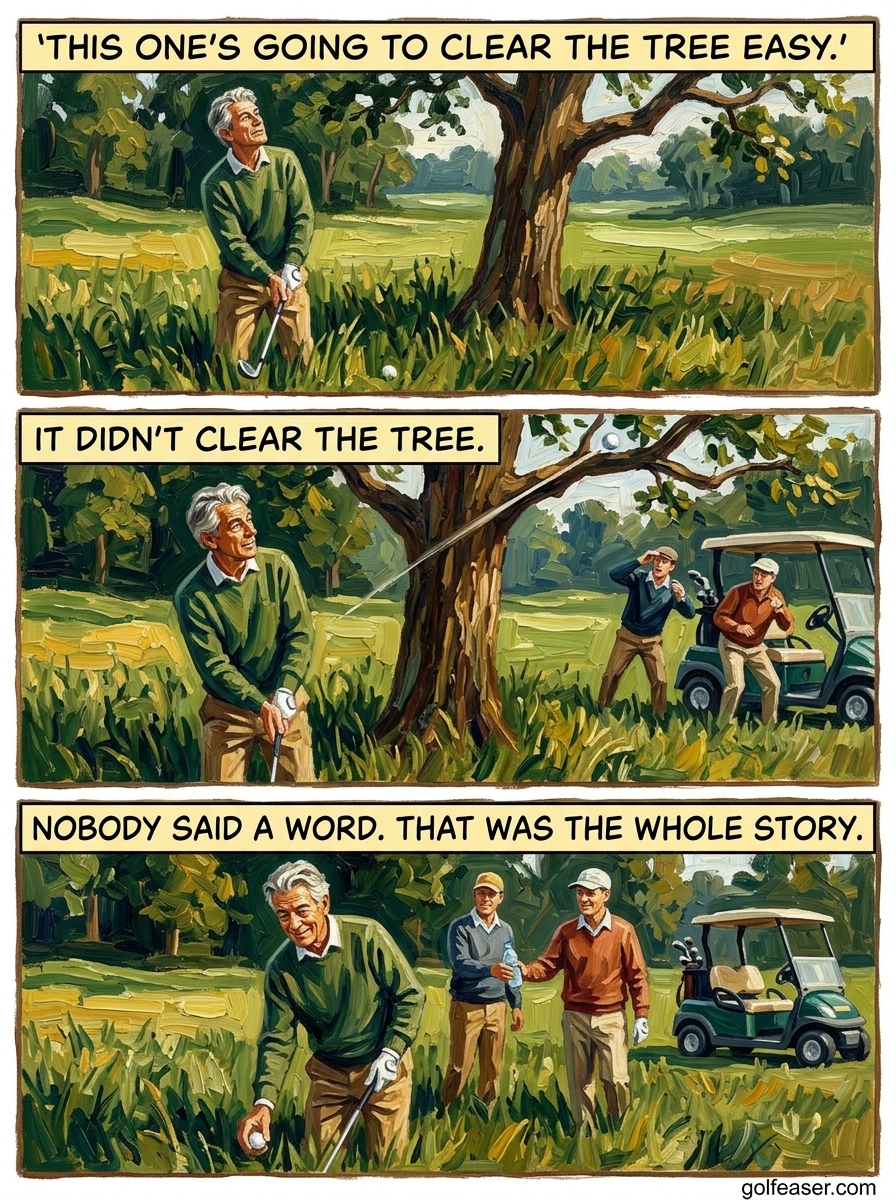
The branch was still swaying when I understood what had happened.
I hadn't even turned to watch the ball land yet — I was still mid-follow-through, still in the pose, still for one full second a guy who'd just pulled off the shot of the year — when the sound reached me a beat late. Not the clean contact-into-open-air sound I'd been expecting. A flat, wooden thock, close, followed almost immediately by something whistling past my left ear at a speed I did not enjoy.
That was the moment I stopped being the hero of my own story and became, instead, the punchline of somebody else's. It happened faster than I could adjust for it — one second composing the version I'd tell at the bar, the next scrambling out of the way of my own golf ball like it owed me money.
What I Was So Sure Was Going to Happen
Here's the setup, because it matters: tenth hole, a par 4 with a lazy dogleg right and a lone, thick-canopied oak that's been sitting about a hundred and forty yards short of the green for as long as anyone in our group has been playing this course. My ball had found the rough behind it — not the fairway rough, the real stuff, the kind where you lose a third of the ball just standing over it and have to guess at your lie by feel. A hybrid in my hands. A gap in the branches directly in my line that I measured, with total confidence and zero actual measuring equipment, at roughly eighteen inches.
Any golfer with a working sense of self-preservation takes one look at an eighteen-inch gap a hundred and forty yards out and hits nine-iron, ninety degrees right, and lives to fight the eleventh with his pride mostly intact. I am not always that golfer. That Saturday, specifically, I was not that golfer at all.
I want to be honest about what was actually going through my head, because it wasn't really golf strategy. It was narrative. I had already, somewhere in the walk from my cart to the ball, started drafting the version of this shot I was going to tell at the bar. I could hear myself telling it. So I'm buried in the rough behind this tree, right, and everybody's already walking toward their own ball assuming I'm chipping out sideways, and then — and here's where, in my head, the story got good. I wasn't standing over a golf shot. I was standing over the opening line of a story I hadn't earned yet.
I'm not totally sure why weekend golf does this to people specifically. You can go six full days without thinking about the game at all — work, kids, whatever's actually on fire that week — and then Saturday morning arrives and some dormant part of your brain wakes up fully convinced you're a completely different level of golfer than the one who last played here. I've watched this happen to other guys in the group too. It's never really about the actual odds of the shot working. It's about how good the story sounds in the two seconds before you swing.
The Part Where the Tree Won
I took the club back with what I can only describe as total, unearned confidence, and I hit a genuinely decent strike on the ball — clean contact, right trajectory, exactly the shot I'd pictured. For about four feet.
The branch caught it dead center. Not a glancing tick that might've deflected it somewhere survivable — a full, flush collision, the kind that makes a distinct and specific sound you don't forget. The ball came back at roughly the speed it left, which meant I had approximately no time to process what had happened before I was stepping sideways out of its way on pure reflex.
My buddy Dave, who'd wandered off toward his own ball and was standing near the cart minding absolutely nobody's business but his own, ducked. Genuinely ducked, both hands up, like we were suddenly playing a different and more dangerous sport. The ball landed in the rough roughly three yards from where I'd hit it — which, doing the actual math on it later, put it closer to my original lie than it was to the green I'd been aiming at. I had, through tremendous effort and total conviction, moved my ball backward.
There's a particular kind of silence that happens on a golf course after a shot like that, and it's different from the silence after a bad shot that was at least believable. A topped drive gets a sympathetic "tough break" or two. A shanked iron gets somebody offering a swing thought you didn't ask for. This got nothing. Dave didn't say a word. He just reached into the cooler, pulled out a water bottle, and held it out toward me without really looking up — the way you'd hand someone a napkin after they'd spilled something, functional and completely unbothered, like this was a scheduled part of the round rather than the disaster I'd just manufactured myself.
The cart was already rolling toward the fairway before I'd finished picking my ball back up out of the rough.
The shot has a name in our group now. Nobody assigned it one on purpose — it just started getting referred to as "the branch," lowercase, no further explanation needed, the way certain moments in a long-running group earn their own private shorthand. Somebody will hit a ball into trouble on an unrelated hole, on a completely different course even, and one of the guys will just say "careful, don't branch it" and the whole cart will know exactly what that means without anyone having to retell the story. That's a strange kind of immortality for a shot that, by any golf measure, was a genuine failure. It didn't advance my ball forward by a single yard. It moved it backward. And nine years later it's still doing more work in the group's shared memory than most of the good shots I've actually hit.
Why the Silence Was the Actual Story
I used to read that kind of silence as disappointment. Like the group had collectively decided I wasn't worth the energy of a reaction, and the water bottle was less a kindness and more a way of saying let's just move on from this. It took me embarrassingly long — years, honestly — to understand it the other way around.
What that silence actually meant was that my group had watched me attempt some version of this exact overconfident play often enough that it had stopped registering as news. There's a real skill in reading the room on the golf course — knowing when a shot needs a reaction and when it needs nothing at all — and it turns out that skill runs both directions. My guys read the room on my behalf before I'd even finished stepping out of the way of my own ricochet. They knew exactly how much attention the moment deserved. They gave it exactly that amount, which was none, and somehow that was the correct and generous response.
I think about this a lot now, actually — how the biggest compliment a group can give you isn't laughing at your disaster or consoling you through it. It's treating it as so unremarkable that nobody breaks stride. That's a group that's stopped needing you to be good. It's just accepted you as a specific, known quantity, branches and all.
The Version of Me That's Never Going to Learn This
Here's the part I've made peace with slower than I'd like to admit: I am never going to be the golfer in this foursome who calmly assesses a buried lie behind a tree and takes the smart, boring, correct shot. Some guys in the group genuinely are that golfer. They see the eighteen-inch gap, do actual math instead of vibes, and punch out sideways without a second thought. I respect them. I am not one of them, and at this point in my golfing life I don't think I'm going to become one.
Being the worst golfer in the group was never really the thing that bothered me anyway — it's more that I've apparently accepted a specific supporting role within it, which is the guy who's going to attempt the shot nobody else would try, on a hole where absolutely nothing is on the line, purely because the failed version makes better material than the safe one would have. My handicap has parked itself in almost exactly the same spot for something close to a decade now, comfortably inside what I've heard other weekend golfers half-jokingly call mid-handicap purgatory, and I've stopped treating that number as a problem I'm supposed to be solving. I'm not out here chasing a lower score. I'm out here chasing the one absurd, low-percentage, tree-defying shot a round — and my foursome, God bless them, has apparently made peace with quietly footing the bill in silence when it doesn't come off.
There's a version of this essay where I tell you I've since learned my lesson, that I take the smart shot now, that the branch taught me something about restraint. That would be a better story. It would also be a lie. I've hit at least four more versions of this exact shot since — different holes, different trees, same basic miscalculation of how big a gap actually needs to be before a rational person attempts it — and my success rate has not meaningfully improved. What's improved is my relationship to the failure. I used to leave the course a little embarrassed by these. Now I leave with a slightly better story than I had that morning, which is, if I'm honest with myself, most of what I actually show up for.
What My Confidence Was Actually About
Here's the thing nobody tells you about a shot like this: it was never really about whether the ball made it through the gap. My golf confidence has never had a whole lot to do with my handicap, and if I'm being completely honest, the failed hero shots have probably done more for my standing in this group than the handful of times the gap has actually cooperated. A clean punch-out earns you nothing memorable. Nobody brings up the smart layup shot you hit on the tenth hole in April three years later at a wedding. But a ball that comes back off a branch fast enough to make a grown man duck behind a golf cart? That earns you a nickname. That gets brought up unprompted, at inconvenient moments, for years.
I've had genuinely rough rounds — the kind where you're quietly doing math around the fourteenth hole on whether you can plausibly leave before eighteen — and the thing that's actually pulled me out of those funks hasn't been a swing thought or a change in strategy. It's usually been exactly this: attempting something stupid, watching it fail in a specific and visible way, and getting to enjoy the group's reaction instead of stewing in my own disappointment. There's a real, learnable skill to knowing how to bounce back after a hole goes sideways, and mine, apparently, is making the next disaster the group's problem to witness rather than mine alone to carry.
I make my foursome better in a lot of small, forgettable ways over the course of a normal round — I keep pace, I know the games, I remember whose turn it is to buy at the turn. But if I'm being honest about which contribution actually lands hardest with these specific guys, it's not any of that. It's the branch. It's being, reliably, the one who's going to try the thing that shouldn't be tried, often enough that watching it fail has become part of what a Saturday with me is supposed to include.
This Wasn't Even the First Time
The branch gets the credit because it's the best story, but it wasn't actually my first attempt at manufacturing a highlight nobody asked for. Two summers before that, on the sixth hole — a par 3 with water carved straight across the front of the green, maybe a hundred and sixty yards at the pin — I'd hit a similar wall of confidence over a shot I had no business attempting. My ball was sitting on a downslope on the wrong side of the pond, and the smart play was a punch-out back to the fairway and a chip-and-two-putt bogey that nobody would remember by lunch. Instead I convinced myself I could carry the whole thing with a 5-wood off a bad lie, because in my head the carry looked generous and the wind looked helpful, neither of which turned out to be true.
The ball came off the club low and hot, skipped once off the surface of the pond like a stone thrown sideways, and disappeared somewhere in the reeds on the far bank. That one actually got a laugh — a real one, from two guys at once, the kind that echoes a little on an open hole. I remember being surprised by that at the time. It felt like a worse shot than the branch would eventually be, and it got a completely different reaction: loud instead of silent, immediate instead of deadpan.
It took me a while to understand why. The water skip was funny because it was clean and visible from a hundred and sixty yards away — everybody watched the whole arc of it happen in real time, stone-skip and all, and there's something inherently comic about a golf ball behaving like it's got somewhere else to be. The branch, years later, wasn't funny in the same way. It was close and fast and mildly alarming, the kind of thing that makes a guy duck for cover rather than laugh out loud. Comedy needs distance. A ball coming back at you at speed doesn't leave room for the laugh — it leaves room for a water bottle, handed over wordlessly, while everyone quietly recalibrates how close that actually was.
I've come to think the group's reaction to any given disaster tells you almost as much as the disaster itself. Laughter means it read as safely absurd. Silence means it read as something closer to a near miss. I've earned both reactions plenty of times since, on purpose and by accident, and at this point I've stopped being able to predict in advance which one a given bad idea is going to get. That's probably for the best. If I could predict it, I might start being more careful, and being more careful was never really the point of any of this.
Why I Still Haven't Stopped Trying It
The tenth hole and its oak tree have personally cost me somewhere north of six strokes over the years, cumulative, by a rough and possibly generous count. I've never once treated that running total as a reason to stop going for the gap. If anything I've gotten worse about it as I've gotten older, which feels like it should embarrass me more than it does.
What actually makes a round worth remembering was never the eighteen holes played cleanly and forgotten by dinner. It's the one thing that goes sideways in a specific, tellable way — and I'd rather be the guy who supplies that material than the guy who plays it safe and gives everyone a perfectly fine, perfectly forgettable Saturday. I earn the right to brag about plenty of things in this group. This isn't one of them. What I've got instead is better, in its own strange way: a shot that's become part of the group's shared vocabulary, referenced any time I so much as glance toward a tree line on a different hole entirely.
Dave still brings up the branch. It's been nine years. He'll bring it up at the 19th hole completely unprompted, mid-conversation about something else entirely, just to watch my face when I remember it happening. I used to find that mildly humiliating. Now I think it might be one of the more durable things I've contributed to this particular group of guys — not a great shot, not a great round, just one very specific, very stupid moment that's outlasted probably a hundred forgettable pars since.
I never did get that shot to clear the branch. I'm nine years in, and I'm not entirely sure I want to anymore. A clean recovery shot gets forgotten somewhere around the fifteenth hole, the same day it happens. The branch, evidently, does not — and if I'm being fully honest, I've quietly stopped measuring the gap as carefully as I used to before I swing. Some part of me has decided the story is worth more than the outcome, and I'm not in a hurry to talk myself out of that particular piece of self-deception.
More Saturdays, Drawn Out
Golf Comics: The Same Saturday, Every Time
Three-panel golf comics about the warm-up that never happens and the group that never waits. Painfully familiar, every time.
I Called Myself an 18. The Round Called Me a 26.
Every group has a guy who announces his handicap on the first tee. The comic strip about what the back nine actually reveals — and why nobody says a word.
The 5:45 Alarm, the 12th-Hole Blowup, and the Pints After
Every weekend golfer knows this exact loop — the alarm you almost ignore, the blowup that makes you swear off golf, and the pints that undo it by dark.


Johnny is a 25-year weekend golfer who's double-booked tee times, forgotten his clubs an hour from the course, and made pretty much every other trip-planning mistake there is — so you don't have to. Guided by The Golfeaser Manifesto, he started Golfeaser.com to prove that weekend golfers are a special, funnier breed who improve the experience, not just the scorecard. He's also the guy behind The Weekend Golfer's Social Playbook — a three-step system for finding your people, running trips that actually come together, and earning the right to brag at the 19th hole.

