- Home
- Weekend Golfer Life
- Comic Strips
- I Called Myself an 18, the Round Called Me a 27
I Announced an 18 on the First Tee. By the 19th Hole, Everyone Knew Better.
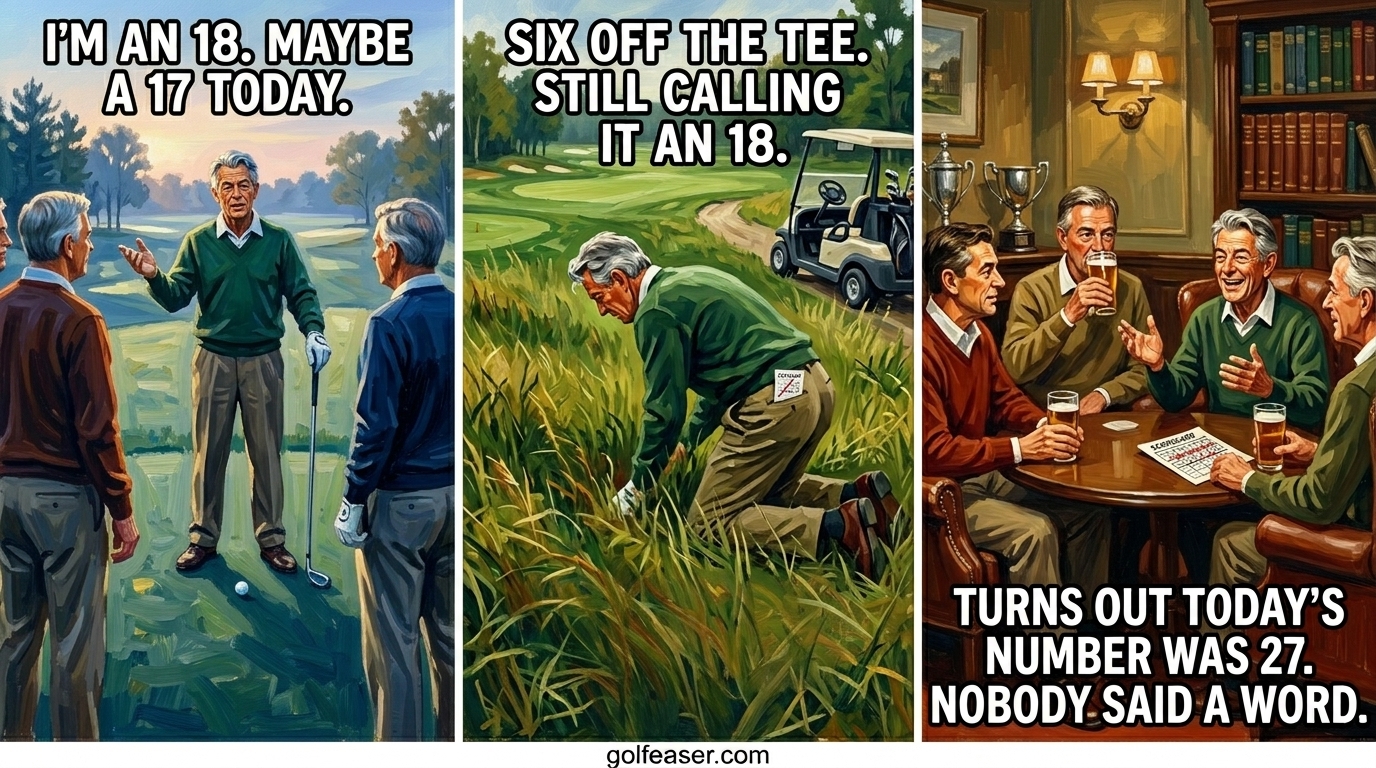
6:58 a.m., first tee, and a guy I'd never met before that morning has already told me his handicap twice.
"I'm an 18," he says, teeing up like he's about to demonstrate it. Then, unprompted, a small addendum: "Maybe a 17 today. Feeling good." Nobody asked. This is a starter-assigned pairing, four strangers who've known each other for ninety seconds, and he's already given us a number before he's given us his last name.
I've been paired with this guy more times than I could count across twenty-five years of Saturday golf, except he's never the same guy twice. He's got a different face and a different voice every time, but he always opens the same way — with a number, delivered slightly too confidently, slightly too early, to an audience that didn't ask for it.
Every Foursome Has One of These Guys
Some groups have a Nassau guy, a slow-play guy, a guy who's always got a new driver he wants to talk about. Almost every group, at some point, has had the handicap-declarer — the guy who wants you to know his number before he's hit a single shot in front of you.
It's not really about the number. It's about what the number's supposed to buy him in the next four hours: a little credibility, a little head start on respect, some assurance that he's not going to be the weak link in a group of strangers. Wanting to impress the guys you're about to spend a round with is about as normal and human an impulse as exists on a golf course. Announcing your handicap is just the fastest, laziest version of trying to do it.
The trouble with that particular shortcut is that golf has an extremely short memory for anything you say and an extremely long memory for anything you do. You get roughly one tee shot before the number you announced starts getting checked against the number you're actually playing to, and golf checks fast.
A Different Guy Every Time, Somehow the Same Guy
I want to be clear that this isn't one specific person I'm describing — it's a type, and I've been paired with a fresh version of him more times than I could reasonably count. There was the guy at a resort course a few years back who announced "14, honestly probably better right now" before he'd even taken a practice swing, and proceeded to lose four balls before the turn. There was the guy at my home muni who told us he "used to be a 9 before kids," a detail that felt less like a handicap and more like a eulogy for a version of himself none of us would ever meet.
What's striking, looking back, is how consistent the shape of the announcement is no matter who's making it. It's never modest. It's never "I'm probably worse than my index says, fair warning." It always rounds up, or rounds recent, or comes with a built-in excuse already loaded — "haven't played in a month," "new clubs," "still figuring out this course" — as if the real number's already been anticipated and pre-forgiven before a single shot has been hit.
I've done a version of it myself, more than once, usually at a course I was self-conscious about playing in front of better golfers. There's a specific flavor of nerves that makes a guy want to establish his credentials early, before the evidence has a chance to contradict him. It rarely works. The evidence always gets a turn.
The Tee Shot That Starts the Math
He hits first, since he volunteered the most information and somebody's got to go. It's not terrible — a low, hooking line that finds the right rough instead of the vastly worse trouble further right — but it's not an 18's tee shot either. An 18 handicap, real ones, tend to find the fairway more than they don't. This one didn't, and it's close enough that nobody's doing arithmetic yet. Just filing it away.
That's the thing about a self-reported handicap on a first tee full of strangers: everybody's quietly auditing it from shot one, whether they mean to or not. It's not malicious. It's just what four competitive men do when a number's been put on the table — they start checking it against the evidence, silently, the way you'd clock a stranger's claimed bench-press max the second he actually gets under the bar.
By the third hole, our guy is finding trouble at a rate that doesn't square with an 18. A ball goes long and right into a stand of trees on a hole that shouldn't punish a mid-handicapper that badly. He heads in after it, and I watch him disappear into the tree line still radiating the same first-tee confidence, like the search is a formality and the ball's basically already found.
He comes back without it. Drops another, still narrating his own round out loud the way guys do when they're trying to talk themselves back into the number they promised everyone at 6:58 that morning — "just a bad break, this isn't usually how it goes for me." Nobody in the cart argues with him. Nobody needs to. The scorecard's already starting to do that job on its own, one scratched-out box at a time.
By hole seven, something in his posture has changed that has nothing to do with his swing mechanics. Fewer practice swings between shots. Less commentary. He's still pleasant, still asking the rest of us about our lives between holes, but the puffed-up energy from the first tee has quietly drained out of him somewhere around the fifth fairway, replaced by the specific, recognizable posture of a man doing math he doesn't like the answer to.
The Back Nine Always Tells a Different Story
By the turn, the math has stopped being subtle. He's playing to something closer to a 27 than an 18, and everybody in the cart knows it, including — somewhere under the surface — him. The tee shot from three holes back has become a pattern: ball in trouble, extra strokes nobody's saying out loud, a scorecard getting a little harder to read the more he scratches out and rewrites.
I'm not totally sure why guys do this to themselves before the round has even started, when the actual round is going to make the true number obvious within about ninety minutes regardless of what got announced on the first tee. My best guess, after two and a half decades of watching it happen from the passenger seat, is that the declaration was never really about deceiving anyone. It's a form of hope, dressed up as a fact. He wanted the round to go the way the number promised, said the number out loud partly to make himself believe it, and then had to spend nine holes finding out the golf course wasn't listening.
There's a particular kind of quiet that settles into a cart around hole fourteen or fifteen when this has been happening all day. Nobody says anything about it directly — that would be its own kind of rude — but the conversation gets a little thinner, the compliments on good shots get a little more genuine-sounding by contrast, and everybody just quietly recalibrates what they actually expected from this group the moment the starter paired them up.
⛳ What the First-Tee Number Actually Tells You
- 📍 An unprompted handicap announcement is usually hope, not a lie — treat it that way
- ⭐ The real number shows up by the turn no matter what got said on hole one
- 🚫 Calling it out mid-round almost never lands the way you'd want it to
- 💡 What sticks by the 19th hole is how he handled the gap, not the gap itself
Why Nobody Ever Actually Calls Him Out On It
Here's the part that took me an embarrassingly long time to notice: almost nobody in a group like this ever says anything about the gap between the announced number and the actual round, even when it's obvious to all three other guys by hole nine. You'd think somebody would eventually say it out loud — gently, as a joke, however — but it almost never happens in real time.
Part of that is straightforward decency. Nobody wants to be the guy who makes a stranger feel small over a betting game or a scorecard on a Saturday morning that's supposed to be relaxed. But I think there's something else going on too, something closer to recognition than restraint. Most of us have been that guy at some point — announced a number we were hoping to play to rather than the number we actually were, and had the round quietly correct us in front of people we'd just met. Calling him out would mean pretending we've never done the exact same thing, and that's a harder pretense to hold onto than just letting it go.
The sandbagger in an established group is a different problem entirely — that's someone deliberately inflating a number for betting advantage over months or years, and it deserves a very different response. This guy isn't that. This guy is just optimistic out loud, in public, on a morning where the golf course was always going to have the final word regardless of what he said first.
The One Time Somebody Actually Said Something
I've only seen the unwritten rule broken once, and it's stuck with me for exactly the reason you'd expect — because it went about as badly as you'd guess. A guy in our group, not a regular, said something around the turn like "you're not really an 18 today, huh" — not even meanly, more observational than anything, the kind of comment that would land fine between two guys who'd known each other for years.
It did not land fine. The tone of the whole back nine changed. Our handicap-declarer got quieter, tighter, started aiming more conservatively off every tee in a way that made his round worse, not better, and by eighteen he'd basically stopped talking to any of us. We never saw him again — not at that course, not in that particular rotating group of Saturday regulars. I don't know if the comment alone did that, but it clearly didn't help.
What that day taught me is that the silence the rest of us usually maintain isn't passivity. It's a decision, even if nobody's consciously making it as one. Calling out the gap between the announced number and the actual round doesn't fix anything or make the golf better — it just adds a second failure on top of the first one, and turns an ordinary bad Saturday into a genuinely bad one. However competitive your group's actual games get, the first-tee number a stranger gives you is basically never worth litigating in real time. Let the round do the talking. It always does, eventually, without any help from you.
What He's Actually Trying to Buy With That Number
Kinda like introducing yourself at a party with your job title before your name — it's not dishonest exactly, it's just leading with the credential instead of the person, hoping the credential does some of the social work so you don't have to. The handicap declaration is the golf-course version of that same instinct. He's trying to buy four hours of assumed competence before he's earned a single minute of it.
The problem is golf doesn't really respect that kind of credential the way a job title might at a cocktail party. The right to brag on a golf course has to be earned inside the actual round, shot by shot, in front of the people watching you do it — it can't be pre-purchased on the first tee with a confident number and a firm handshake. Every one of us already knows this, which is exactly why it's so easy to recognize the move when someone else tries it, and so tempting to try it ourselves anyway.
When It's Your Own Group Instead of a Random Pairing
Everything above assumes strangers on a first tee, which is where this scene plays out most cleanly — nobody has history, so the number gets taken at face value until the round corrects it. It gets more complicated when the handicap-declarer is one of your regular guys, someone who's been in your rotation for years and does a milder version of this same thing most Saturdays.
That's a genuinely different situation from the one-off stranger comic, and it deserves different handling. A guy you play with every week who consistently rounds his number down isn't hoping out loud on a single morning — he's shaping how your group's bets and handicap strokes get calculated over time, which actually costs the rest of you money and fairness, hole after hole, season after season. Getting your group's handicapping actually fair matters a lot more in that context than it does with a random pairing you'll likely never see again. The stranger's inflated 18 is a one-morning story. The regular's is a standing tax on every Nassau you play together.
The tell is usually the same either way — the announced number and the on-course number keep drifting apart, round after round — but the response has to scale with the stakes. One bad morning from a stranger, let it go, the way I've argued all along. A pattern from someone in your permanent four, over enough Saturdays, is worth a real conversation, ideally not mid-round and not in front of an audience.
The Handicap That Actually Matters by the 19th Hole
At the clubhouse table after, scorecards get tossed on the table the way they always do, and somebody's eyes drift over and clock the real number — a 27, not an 18, not even close to the 17 he was feeling good about at 6:58 that morning. Nobody says anything. He's mid-story about something unrelated, some near-miss on fifteen he's decided is the highlight of the round, and three guys let him have it because by then it genuinely doesn't matter anymore.
That's the real twist in this comic, if it has one. The gap between the announced 18 and the actual 27 stopped being the interesting part of the day somewhere around hole twelve. What replaced it was simpler: was he good company for four hours? Did he laugh at the tree-line disaster instead of sulking through the back nine? Did he buy a round after, the way you're supposed to when you've clearly lost whatever unspoken contest the morning's number implied?
If the answer to those questions is yes, the actual handicap becomes trivia by the time everyone's finished their first beer. However your group actually handles handicaps and fairness in the games that matter — the ones with money on them — that's a conversation for the first tee of the next round, not a referendum held quietly at the bar over this one.
I've been on both sides of this exact comic more times than I'd like to admit — the guy doing the announcing, and the guy in the cart quietly doing the math. Being a weekend golfer means you're going to end up on both sides of it eventually, probably more than once a season, and the only real skill worth developing is handling either side of it with a little grace. Own the bad number when it turns out to be the real one. Don't make a big deal out of someone else's.
If you're the guy on the first tee tempted to round your handicap down before anyone's seen you swing, here's the honest offer: play the number you actually are. The right game format can make an honest 27 just as fun to play as a fictional 18 — sometimes more fun, since nobody's quietly doing math on you all morning instead of just enjoying the round. There are betting formats built specifically for wide handicap spreads so an honest number never has to feel like a liability at the first tee. And if the whole group's mixed enough that fairness feels like a real question, there's an entire library of games built for exactly that problem — worth a look before your next round with strangers, or with the same three guys you've been rounding up for a decade.
The scorecard from that morning is long gone. What's left is the story — the 27, the tree-line disaster, the guy who let it go without making it weird. That's the number that actually stuck.
Here's the part worth remembering the next time you're tempted to round your own number down on a first tee full of strangers: whatever you announce at 6:58 in the morning has an expiration date measured in holes, not hours. The real number always wins by the turn. But the round after this one is a clean slate regardless of what happened on this scorecard — you're always just one round away from the number matching the announcement, and until then, the only thing anyone's actually grading you on is whether you were good company while you found out.
More Saturdays, Drawn Out
Golf Comics: The Same Saturday, Every Time
Three-panel golf comics about the warm-up that never happens and the group that never waits. Painfully familiar, every time.
The 5:45 Alarm, the 12th-Hole Blowup, and the Pints After
Every weekend golfer knows this exact loop — the alarm you almost ignore, the blowup that makes you swear off golf, and the pints that undo it by dark.
The Recovery Shot I Was Already Bragging About
He was already telling the story before he swung. Then the branch took it back — and why the silence that followed said more than a laugh ever could.


Johnny is a 25-year weekend golfer who's double-booked tee times, forgotten his clubs an hour from the course, and made pretty much every other trip-planning mistake there is — so you don't have to. Guided by The Golfeaser Manifesto, he started Golfeaser.com to prove that weekend golfers are a special, funnier breed who improve the experience, not just the scorecard. He's also the guy behind The Weekend Golfer's Social Playbook — a three-step system for finding your people, running trips that actually come together, and earning the right to brag at the 19th hole.

