- Home
- Weekend Golfer Life
- Comic Strips
- The 5:45 Alarm, the 12th-Hole Blowup, and the Pints After
The 5:45 AM Alarm, the 12th-Hole Blowup, and the Pints That Undo Both
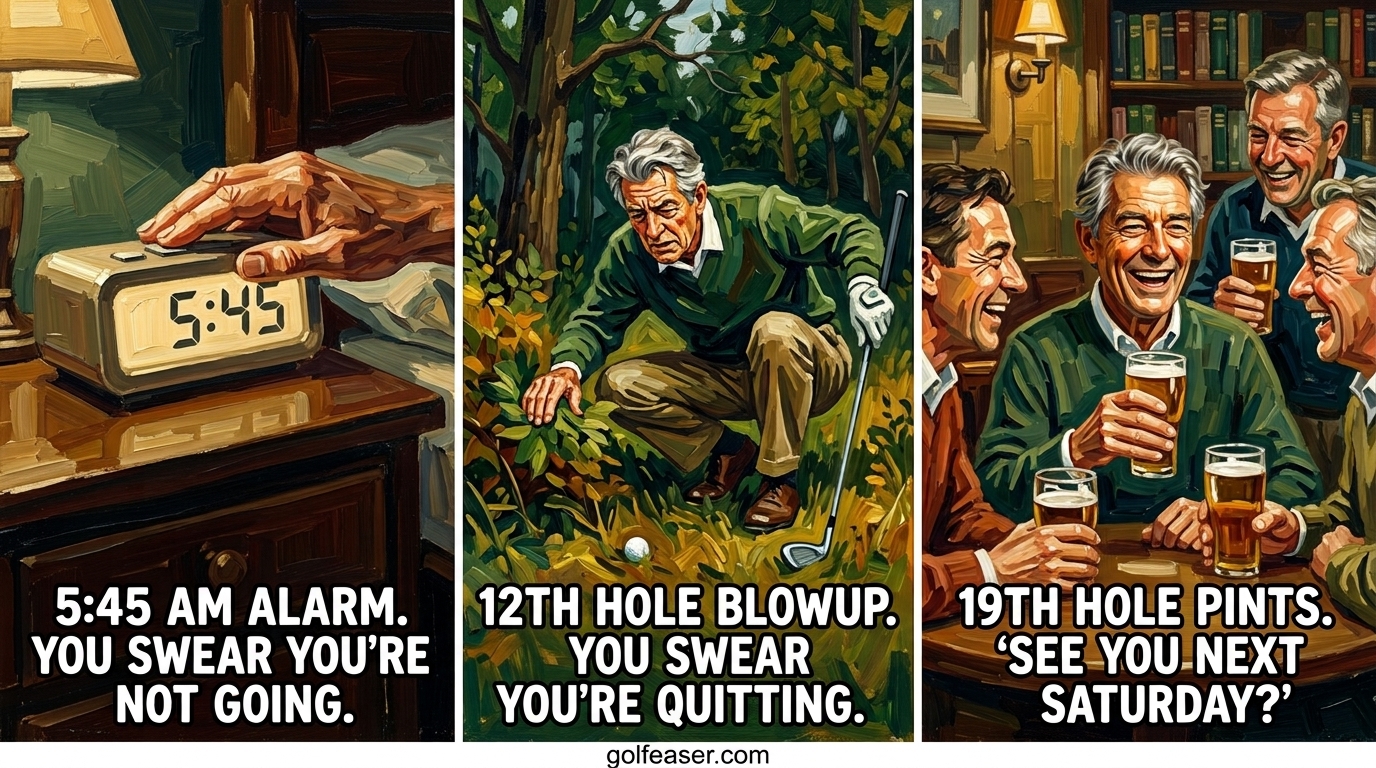
I have hit snooze on a 5:45 alarm meant for golf more times than I've hit a fairway square, and I have never once actually stayed in bed. That's not willpower. That's just what the alarm is for — it's not really asking whether you're going, it's just giving you sixty seconds to complain about it before you get up anyway.
Every regular Saturday golfer I've ever known runs the same three-part loop, on repeat, for years, sometimes decades. The alarm you swear you're not answering. The hole — there's always a specific hole — where the round falls apart badly enough that you mean it, actually mean it, when you say you're done with this game. And then the pints after, where somebody asks about next Saturday and you're already nodding before you've finished chewing.
What's strange, looking at this pattern laid out across three panels instead of living inside it week to week, is how completely predictable the whole cycle is and how little that predictability seems to matter. You'd think knowing exactly how the day is going to go — dread, disaster, redemption, repeat — would eventually talk you out of setting the next alarm. It never does. If anything, the predictability is part of the appeal, the same way a favorite movie doesn't lose anything by you already knowing how it ends.
The Alarm You Set Yourself and Still Resent
There's a specific kind of dread that comes with a 5:45 alarm on a Saturday, the one day nobody's making you get up early. You set it yourself, the night before, fully sober and fully willing. And then it goes off, and some version of you that didn't agree to any of this reaches over and genuinely considers letting the tee time go.
I'm not totally sure why the resentment shows up even though the whole thing was your idea. My best guess is that 5:45 doesn't know it's golf yet — in the dark, half-asleep, an alarm is just an alarm, and your body reacts to it the same way it would react to any other reason to get up before the sun. It takes about ninety seconds of actually being upright before the golf part of your brain catches up and reminds you why you're doing this.
The Saturday morning ritual isn't really about the tee time itself — it's about the specific, repeatable shape of the whole morning: the alarm, the coffee made too fast, the clubs already loaded in the trunk from the night before because 5:45-you doesn't trust 5:45-you to remember anything. By the time the car's actually moving, the complaint from the alarm is already gone, replaced by something closer to anticipation.
The Same Hole, Different Years, Different Disasters
The twelfth hasn't just been one bad round to me — it's been a whole recurring cast of specific disasters over enough years that I could probably write a short history of my golf game entirely through what's happened to me on that one green. There was the year I three-putted it four Saturdays running, which felt less like bad luck and more like the hole developing a personal opinion of me. There was the Saturday my ball found the same greenside bunker twice in one round, out and back in, a feat none of the guys have let me forget since.
Every regular group I've ever been part of has a hole like this, and it's rarely the hardest one on the card by any official measure. It's just the one that seems to know exactly which mistake you're most prone to making and waits there, patiently, for the day you make it in front of an audience. Mid-handicap purgatory has a way of finding its favorite stage, and mine has a green that slopes away just enough to turn a slightly-too-firm approach into a long, humbling walk back down to retrieve the ball you just watched roll off the front.
I've heard versions of this same story from guys in totally different groups, on totally different courses, and the shape is always identical even when the hole number changes. Ask anyone who plays the same course regularly which hole they dread, and they'll answer instantly, usually with a specific memory already loaded and ready to go.
What Changes Depending on Who's Having the Blowup
The group's reaction to a twelfth-hole disaster isn't uniform — it shifts depending on who's having it, and I've watched this play out enough times to notice the pattern. When it's the guy who's normally steady, the group goes quiet and respectful, the way you'd go quiet around anyone having an uncharacteristically bad day. When it's the guy who blows up on some hole almost every week, the reaction is closer to affectionate ribbing, because at that point the disaster is less a surprise and more a returning character in the ongoing story of your Saturdays together.
I've been both versions of that guy at different points across twenty-five years. The steady stretches and the stretches where I couldn't seem to find a fairway to save my life have both happened to me, sometimes within the same season, and the group has adjusted its reaction accordingly every time without anyone announcing the shift out loud. That's part of what makes a regular group work as well as it does — nobody has to explain that this week calls for sympathy and last week called for a joke. Everybody already knows.
Why the Blowup Always Comes Around the Same Hole
Every regular group has a hole like this — not the hardest hole on the course, necessarily, but the one that seems to specifically know how to end a good round. For our group it's the twelfth, a mid-length par-4 with a green that slopes away from you just enough to make a decent approach shot look foolish. I've had rounds that were genuinely good through eleven holes completely fall apart on that green, more times than feels statistically reasonable.
The blowup itself is rarely one bad shot. It's three or four in a row, compounding — a pulled drive into the rough, a chunked approach that doesn't reach the green, a chip that runs ten feet past, a missed putt coming back. By the time you're marking down the number, it's not a bogey or even a double, it's the kind of number you have to actually recount to believe. And somewhere in that stretch, out loud, to nobody in particular, you say some version of "that's it, I'm done with this game."
Mike asked me once, right after a blowup like that, whether I actually meant it when I said I was quitting. I told him yes, completely, in that exact moment. He just nodded and kept walking to the next tee, because he already knew — the same way I'd have known if the roles were reversed — that the quitting only lasts as long as the walk to the next hole.
The Vow on the Tee Box Nobody Actually Believes
Here's the thing nobody talks about with this particular vow: everybody in the group has heard it before, from this exact guy, more times than either of you could count, and nobody treats it as information. It's understood, the way weather complaints are understood, as something you say because the moment calls for it rather than because you're announcing an actual decision.
I've watched guys declare they're quitting golf forever on a Tuesday twilight round and then text the group chat by Thursday asking who's in for Saturday. The love-hate relationship that is weekend golf isn't a flaw in how we play the game — it's basically the entire emotional engine of it. A game you never got frustrated with wouldn't be worth much of anything when it finally goes right.
There's a version of this that's honest self-talk in the moment and a version that's performance for the group, and it's usually both at once, layered on top of each other. You genuinely feel the frustration — the twelfth hole took something real from you, a shot at a good number, maybe some pride in front of the guys watching. But some part of you also knows the declaration is a little bit theater, a release valve dressed up as a decision, and that you'll be teeing off on thirteen in about four minutes regardless of what you just said.
When the Vow Turns Out to Be Real
I should be fair to the exceptions, because they do exist, and pretending otherwise would flatten something true about this cycle. I've known a couple of guys over the years whose "I'm done with this game" on some disaster hole turned out to be the actual last round they ever played with us — not because the golf broke them, but because life had already been quietly pulling them away, and that particular blowup just happened to be the moment they said the thing out loud that had been building for months.
The tell, looking back, was never the volume of the declaration. It was everything around it — fewer Saturdays showing up in the first place, tee times that kept almost not happening, a general sense that the alarm wasn't getting answered as reliably as it used to. Why we keep playing at all is a question that has a real answer for most of us most of the time, but it's not a permanent answer, and every regular group eventually loses somebody to a version of this exact scene that turns out not to have a fourth panel.
That's rare, though, genuinely rare, compared to how often the vow gets made and un-made in the same afternoon. Most twelfth-hole quittings are just weather. A small number are actually a forecast. The difference only becomes obvious in hindsight, which is exactly why nobody in the cart ever treats a single declaration as proof of anything.
What Changes By the Time You're Signing the Card
The strange part is how completely the blowup gets absorbed by the time the round actually ends. Not forgotten — you'll remember the twelfth hole disaster clearly enough to bring it up yourself later — but it stops being the emotional center of gravity it was for those five or ten minutes right after it happened. Something about finishing the remaining holes, even badly, has a way of resetting the whole thing.
Bouncing back after a disaster hole isn't really a skill you practice on purpose so much as something that happens to you automatically, mostly because the alternative — sulking through six more holes — is worse than just playing them out. By seventeen or eighteen, whatever you said on twelve has quietly downgraded from a decision to a story, which is a much better thing for it to become.
I've noticed the guys who actually do walk away from a group for good rarely announce it on a tee box mid-blowup. The real goodbyes tend to be quiet, logistical, decided somewhere off the course entirely — a move, a bad knee, a Saturday that got claimed by something else permanently. The loud "I'm done with this game" on the twelfth hole has never, in my experience, been the real thing. It's the sound of frustration finding an exit, not an actual exit.
There's also something almost useful about the ritual of the disaster hole once you stop fighting it. Six or seven more holes have to get played regardless of what got said on twelve, and playing them badly on purpose out of spite never actually feels better than just playing them straight and letting the number land wherever it lands. Most guys figure this out without ever articulating it — the fastest way through a blowup is directly, not around it.
The Pints That Undo Everything You Said on Twelve
By the time the four of you are actually sitting down at the 19th hole, the twelfth hole has already started its transformation from disaster into material. Somebody brings it up first — usually not the guy it happened to — and it gets told back to him with just enough exaggeration to make everyone laugh, including, eventually, him.
This is where what happens after the round does more work than people give it credit for. It's not just a beer after golf. It's the part of the day where the round gets edited down into the version you'll actually remember — where a triple bogey on twelve turns from a personal failure into a bit the group will reference for the next month. Nobody's minimizing what happened. They're just recontextualizing it into something that's actually fun to have been part of.
There's a specific physical shift that happens around the table too, if you're paying attention. The guy who was quiet on the back nine starts talking again. Someone finally cracks the joke about the twelfth that's been sitting there since it happened, and the guy it's about laughs before anyone else does — which, more than any actual words, is the real sign the round's officially over and the story's officially begun.
Somewhere in the second round of pints, somebody asks the question that's been implied the entire time without anyone actually saying it out loud: same time next Saturday? And the guy who was, two hours earlier, completely finished with this sport, says something like "yeah, I'm in" before he's even set his glass down. Nobody in the group finds this contradictory. It's not treated as a reversal. It's just understood as the last beat of a story that always ends this way.
I've sat at that same table often enough to know exactly how it plays out before it happens, which somehow never makes it less satisfying to watch happen again. There's a comfort in a ritual that resolves the same way every time, the same way a familiar song still lands even after you've heard every note coming. The twelfth-hole guy gets his round of applause disguised as a joke, buys a round himself in quiet acknowledgment, and by the time the tab's split the whole disaster has been fully absorbed into the group's shared memory instead of sitting alone in his.
Somebody's already got their phone out by the last round, scrolling to next Saturday on the calendar, holding it up like it needs a vote. It never actually does. Three heads nod without looking up from their glasses, and that's the whole negotiation — no debate, no reluctance performed for show, just four guys quietly re-upping for another one of these before they've even finished processing the last one.
Why You'll Set the Alarm Again Next Friday Night
What actually motivates you to book the next tee time after a round that ended in a genuine, out-loud vow to quit is worth sitting with for a second, because it isn't stubbornness and it isn't denial. It's closer to the thing that keeps you coming back to anything worth doing regularly — the good parts were good enough to outweigh the twelfth hole, and you know that by the time you're actually setting Friday night's alarm again.
I make my foursome better mostly by being the reliable one in this exact cycle — the guy who shows up at 5:45 complaining and stays until the last pint, blowup and all, every single Saturday for longer than I'd like to admit out loud. That's not a special skill. It's just showing up for the whole loop instead of only the parts that feel good, which is honestly most of what being a decent playing partner comes down to, and most of what a whole life spent as a weekend golfer actually amounts to once you zoom out far enough.
You're always just one round away from the twelfth hole going differently, or from a round with no blowup at all — and until that happens, the alarm, the disaster hole, and the pints after are basically the whole deal, on repeat, for as long as you and your group keep showing up for it. That's the actual promise behind every Saturday tee time, whether or not the twelfth hole cooperates. Next Friday night, you'll set the alarm again. You already know you will.
More Saturdays, Drawn Out
Golf Comics: The Same Saturday, Every Time
Three-panel golf comics about the warm-up that never happens and the group that never waits. Painfully familiar, every time.
I Called Myself an 18. The Round Called Me a 26.
Every group has a guy who announces his handicap on the first tee. The comic strip about what the back nine actually reveals — and why nobody says a word.
The Recovery Shot I Was Already Bragging About
He was already telling the story before he swung. Then the branch took it back — and why the silence that followed said more than a laugh ever could.


Johnny is a 25-year weekend golfer who's double-booked tee times, forgotten his clubs an hour from the course, and made pretty much every other trip-planning mistake there is — so you don't have to. Guided by The Golfeaser Manifesto, he started Golfeaser.com to prove that weekend golfers are a special, funnier breed who improve the experience, not just the scorecard. He's also the guy behind The Weekend Golfer's Social Playbook — a three-step system for finding your people, running trips that actually come together, and earning the right to brag at the 19th hole.

