- Home
- Social Survival
- The 19th Hole
- How Long to Stay
How Long You're Actually Supposed to Stay at the 19th Hole (And How You'll Know)
Dave's got his keys out on the table. Not in his hand — on the table, next to his half-finished beer, which is either a signal or just where he put his keys. Mike's ordering a second round like the round never ended. And you're sitting there doing the math on whether leaving now makes you the guy who bails, or staying another twenty minutes makes you the guy who doesn't know when to read a room.
Here's the honest answer: there's no set time. The 19th hole doesn't run on a clock — it runs on the group's actual mood, and that mood usually announces itself in the first two rounds of drinks. Watch for the tells instead of the minute hand, and you'll almost always land it right.
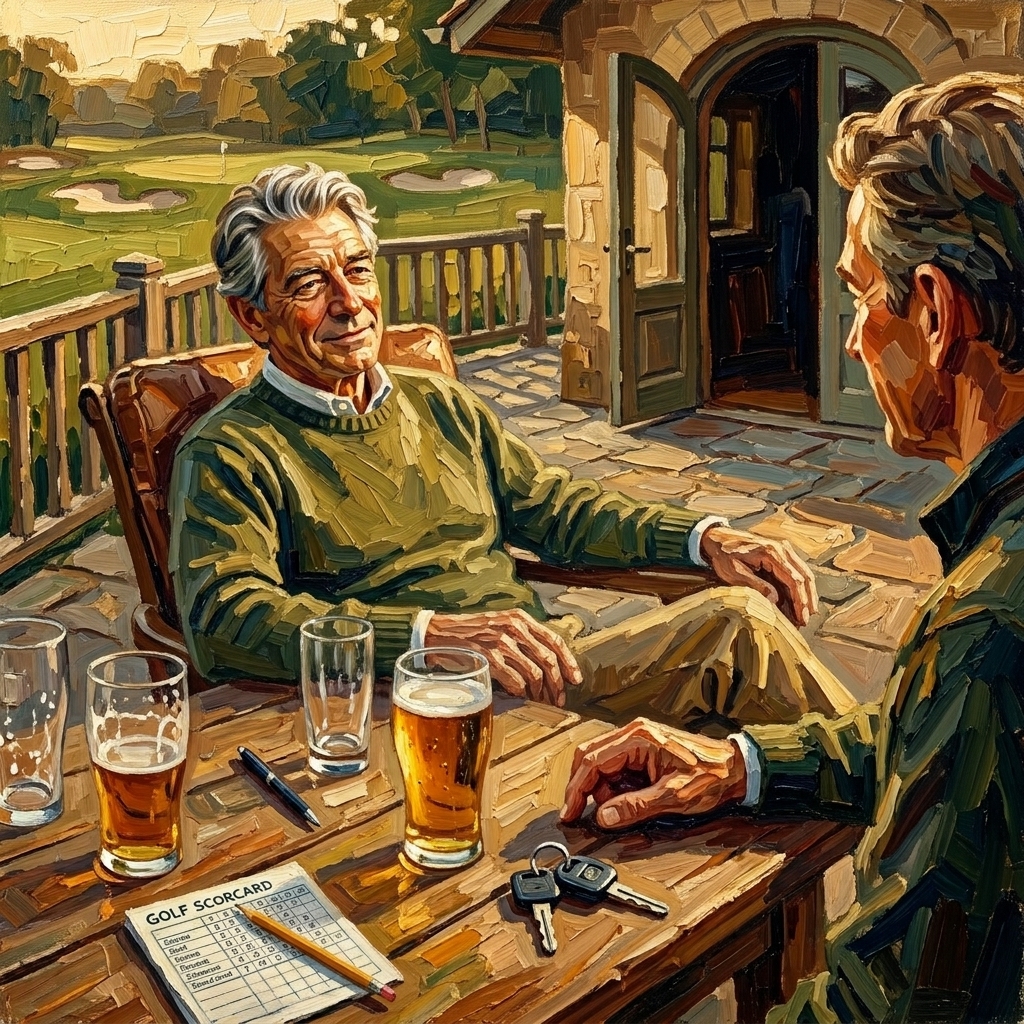
Dave's keys have been sitting on that table for twenty minutes now. That's not nothing.
Why Nobody Ever Tells You How Long to Stay
Nobody teaches this one, because nobody thinks it needs teaching. You learn ready golf from a scorecard pamphlet and dress codes from a sign in the pro shop. The 19th hole comes with nothing. You're just supposed to know.
I didn't, for years — I'd either bolt the second my card was signed, worried I was overstaying a welcome nobody had actually revoked, or I'd be the last one still talking while three guys had quietly checked out and were just being polite about it. Neither version made me the guy people wanted to golf with again.
The insight, once I actually paid attention, was embarrassingly simple: the group tells you constantly, in real time, whether it wants twenty more minutes or wants to be home for dinner. You just have to stop treating the 19th hole like a fixed appointment and start treating it like the rest of the round — reading the room the same way you'd read whether your group wants small talk between shots or silence. It's the same skill as reading the room on the course, just applied to a bar table instead of a fairway.
That's principle two of the Manifesto in its smallest possible form — improving your own experience isn't always about your swing. Sometimes it's just getting the exit right so the day ends on a good note instead of an awkward one.
Get the read wrong and you'll know it fast, even if nobody says a word. The conversation gets a beat slower right after you ask "one more?" and someone answers "sure" in a tone that means the opposite. Or you stand up to leave and three guys look up like you've just interrupted something — not annoyed, exactly, just recalibrating. Neither moment is a disaster. But you feel it, and it's exactly the kind of small friction that's completely avoidable once you know what to watch for.
What Are the Signals That It's Time to Go?
Short answer: phones, posture, and repetition. If someone's checked their phone twice in five minutes, if a chair's turned toward the parking lot, or if you've heard the same story about the 7th hole told twice already, the room has moved on even if the conversation hasn't caught up yet.
Why does this work as a read? Because none of those three things happen by accident. A guy who's fully present doesn't check the time unprompted — he's already doing math about the drive home, or what he told his wife, or the thing at 6pm he's now cutting it close for. The posture shift is the same tell your body gives at a party you're ready to leave: feet angled toward the door before your mouth admits it.
The story-repeating one is the sneakiest, because it feels like the opposite of winding down — everyone's still talking, still laughing. But a group that's genuinely locked in tells new stories. A group that's running out of runway starts re-airing the greatest hits. If you notice your table telling the same joke about the shanked drive on 11 for the second time, that's not a sign to order another round — it's the room's way of saying it's coasting to a stop. Whoever's buying this round should probably also be the one calling it.
What Are the Signals to Stick Around a Little Longer?
The flip side matters just as much, because bailing early has its own cost. If drinks keep showing up without anyone flagging the server down, if the group starts planning next Saturday's tee time before this one's even fully wrapped, or if somebody pulls out their phone to show a photo instead of check the time — that's the table telling you it's not done yet.
I almost missed this one at a buddy's retirement round two summers ago — cards were signed by 1pm and I figured we'd be gone by 2. Instead the second round of beers came, then a third, and somewhere around hour two Jim was retelling our first-ever group trip like it was brand new. Nobody ever said "let's stay" out loud — the drinks and the stories just kept being fresh ones, and that turned out to be the whole answer.
The mistake people make here is assuming the 19th hole is inherently a wind-down — that it exists to gently taper off before everyone drives home. Sometimes it's the opposite. Sometimes the round was the appetizer and the table is the actual event. A round of trivia nobody saw coming or an argument about whether golf even counts as a sport can turn a quick beer into the best two hours of the day — and leaving on schedule in that moment is the actual mistake, not the overstay.
⛳ Unwritten Rules of the 19th Hole Table
- 💰 Whoever's buying the round is usually the one with the authority to call it — let them lead the exit
- 🚫 Don't announce you're leaving mid-story — wait for a natural gap, even if it costs you two extra minutes
- ✅ If you're the one who has to go, say so early rather than letting it hang — "I've got 45 minutes" sets expectations for everyone
- 📍 A round that ends at the cart, with no table time at all, isn't wrong — some groups just aren't 19th-hole groups, and that's fine too
The Two Guys Nobody Wants to Be
There are two ways to get this wrong, and they're mirror images of each other.
The guy who leaves too early is the one who signs his card and is in his car before anyone's finished their first sip. He's not rude, exactly — he's just opted out of the part of the day that actually builds the group. Do it enough times and your buddies stop bothering to ask if you're staying. They just assume you're gone, and eventually they stop noticing either way.
The guy who never leaves is the opposite problem. He's still holding court an hour after the table's clearly done, retelling the front nine shot by shot while two guys are checking rideshare apps under the table. This is the one I actually worry about more, because it's harder to see from the inside — nobody wants to be the guy who relives every shot at the bar after everyone else has quietly moved on.
Staying too long isn't really about the minutes. It's kinda like being the last person to leave a house party who insists on helping clean up — technically generous, but at some point the host just wants you to go home so they can lock the door. The 19th hole works the same way. Good company outstays its welcome exactly once before people start planning their exits around avoiding you.
Neither mistake announces itself right away. Leave too early enough times and you simply stop getting the "you sticking around for one?" text at all — nobody decides to exclude you, the invite just quietly stops including the option. Overstay enough times and the group starts scheduling around you without saying so: a round that used to end at the bar starts ending in the parking lot instead, and you're the reason, even though nobody will ever tell you that directly.
Does the Answer Change Depending on Who's at the Table?
It does, and pretending otherwise is how people misread rounds that were never going to follow the usual pattern.
A round with your boss or a client runs on a shorter clock than you think. I'm not totally sure why, but those rounds always seem to wrap up forty minutes earlier than the ones with my regular guys — everyone's a little more aware of the time, and nobody wants to be the one still at the table when someone's phone buzzes with a reason to leave. One drink, genuine conversation, then let them set the pace on whether it goes longer. If you're playing a round with your boss or golfing with a client, staying past the point they've clearly wrapped up reads as not picking up on cues at work — which is a worse look than leaving five minutes "early."
A first round with a brand-new group is the opposite problem — you genuinely don't have enough data yet to read the table, because you don't know these guys' baseline. The safest move if you're joining a new golf group is to follow whoever invited you. If they're staying, stay. If they're heading out, go with them. You'll have the read down by round three; round one isn't the time to test it.
Your standing weekend crew is the one where all of this actually applies in full — because you know them well enough to catch the tells, and they know you well enough that a clean early exit or a long lingering one both read exactly as intended. That familiarity is the whole reason the signal-reading works at all. With strangers or colleagues, you're guessing. With your regular guys, you're just paying attention.
My Actual Rule, For What It's Worth
Twenty minutes past the first "should we get one more?" I make a real decision — stay properly or leave cleanly, no hovering in between. One drink minimum if I'm buying the round; two if someone else called it. If I've got a hard stop, I say it out loud before the first round even lands on the table, not fifteen minutes before I need to leave. That's it. That's the whole system.
It's not sophisticated, and it doesn't need to be. Used to leave the second my card was signed — no explanation, just gone, car already halfway out of the lot before anyone noticed I hadn't said bye. After a buddy asked point-blank why I always disappeared, I started announcing my window out loud before the first round even landed: "I've got forty-five minutes, then I'm out." Nobody's asked why I bailed early since, and nobody's asked why I stuck around either — they just plan the table around whatever I said at the start.
The rule holds up because it takes the guessing out of it for everyone, not just you. A group that knows your window can talk freely without wondering if you're about to check out mid-sentence. That's a small thing that makes a bigger difference than it should.
What You're Actually Protecting When You Leave on Time
Here's the thing nobody talks about: the 19th hole isn't really about the drinks. It's the only part of the day with zero structure — no format, no stakes, no next shot to think about — which makes it the one place your group actually just talks to each other. Getting the exit right isn't etiquette for its own sake. It's protecting the one unstructured hour a week where your foursome gets to just be four guys instead of four scores.
I used to think staying later was always the more generous move — more time together has to be better, right? Something happened. Something changed. I started noticing that the groups I actually wanted to keep golfing with weren't the ones who stayed the longest. They were the ones who read it right, stayed exactly as long as the day called for, and left everybody wanting the next Saturday to come faster. That's principle six in its purest form — you don't have to be the funniest guy at the table to make it better. You just have to be the one who gets the ending right.
Fellow Golfeasers, this is the part of the day nobody writes rules for, which is exactly why getting it right matters more than any of the ones that are written down.
🎯 Reading Your Exit From the 19th Hole
- ⭐ There's no fixed clock — the room tells you constantly, you just have to be watching for it
- 🚫 Phones out, chairs turned toward the door, and repeated stories all mean it's time to close it out
- ✅ Drinks arriving unprompted and fresh stories still surfacing mean the table's not done with you yet
- 💡 Say your timeline out loud early — it's easier to leave on schedule than to escape one
🏌️ Got a Golf Story?
Share it with us. Every story we publish earns the author a free copy of The Weekend Golfer's Social Playbook — our three-step system for finding your people, running trips that actually come together, and earning the right to brag at the 19th hole.
Or join the Golfeasers — free weekly content for people like us.
Questions About Staying (or Going) at the 19th Hole
Is it rude to leave right after signing your scorecard? Not inherently — some groups aren't 19th-hole groups, and heading straight out is completely normal if that's the pattern. It only reads as rude if the rest of the table is settling in for drinks and you bolt without saying anything.
What if I have to leave but nobody else is ready to go? Say it early and specifically — "I've got 45 minutes" — rather than trying to slip out unnoticed. A clean, announced exit almost never lands badly; a sudden disappearance does.
Does the person buying the round get to decide when it ends? Not officially, but in practice they usually set the pace, since ordering another round is often the real signal that the table's staying. If you want to leave and they're ordering again, it's fine to opt out of that round specifically.
How is this different from reading the room during the actual round? It's the same skill, just off the course. Reading tells during play is about pace and mood between shots; reading them at the table is about posture, phones, and whether the stories are still new.
What if the group can't agree — half want to stay, half want to go? That's usually a sign the group itself has more than one rhythm, which is its own conversation worth having — sometimes gently through foursome dynamics rather than forced in the moment. For that one round, split it: the ones leaving say so and go, the ones staying stay, and nobody has to negotiate a group consensus over a beer.
Keep Reading Before Your Next Trip to the Bar
- The 19th Hole: Why What Happens After the Round Matters Most
- The Quiet Code of Who Buys Drinks After
- Telling a Golf Story at the Bar So Non-Golfers Don't Zone Out
- Reading the Room: When to Talk and When to Shut Up
- The Weekend Golfer's Social Survival Guide

Johnny is a 25-year weekend golfer who's double-booked tee times, forgotten his clubs an hour from the course, and made pretty much every other trip-planning mistake there is — so you don't have to. Guided by The Golfeaser Manifesto, he started Golfeaser.com to prove that weekend golfers are a special, funnier breed who improve the experience, not just the scorecard. He's also the guy behind The Weekend Golfer's Social Playbook — a three-step system for finding your people, running trips that actually come together, and earning the right to brag at the 19th hole.
