- Home
- Social Survival
- The 19th Hole
- Reliving Every Shot
The Guy Who Relives Every Shot at the Bar (And How to Not Be Him)
I'm three sentences into the flop shot on 14 for the second time in an hour, hand still doing the little wrist snap in the air to show how it came off the clubface, when Dave picks up his phone and starts scrolling. He's not being rude about it. He's just done — he heard this one at the turn, and he's too polite to say so out loud.
That's the whole problem in one image. The story was good enough to earn a second telling in your head. It wasn't good enough to earn a second telling out loud, and somewhere between the ninth green and the bar, nobody told you that.
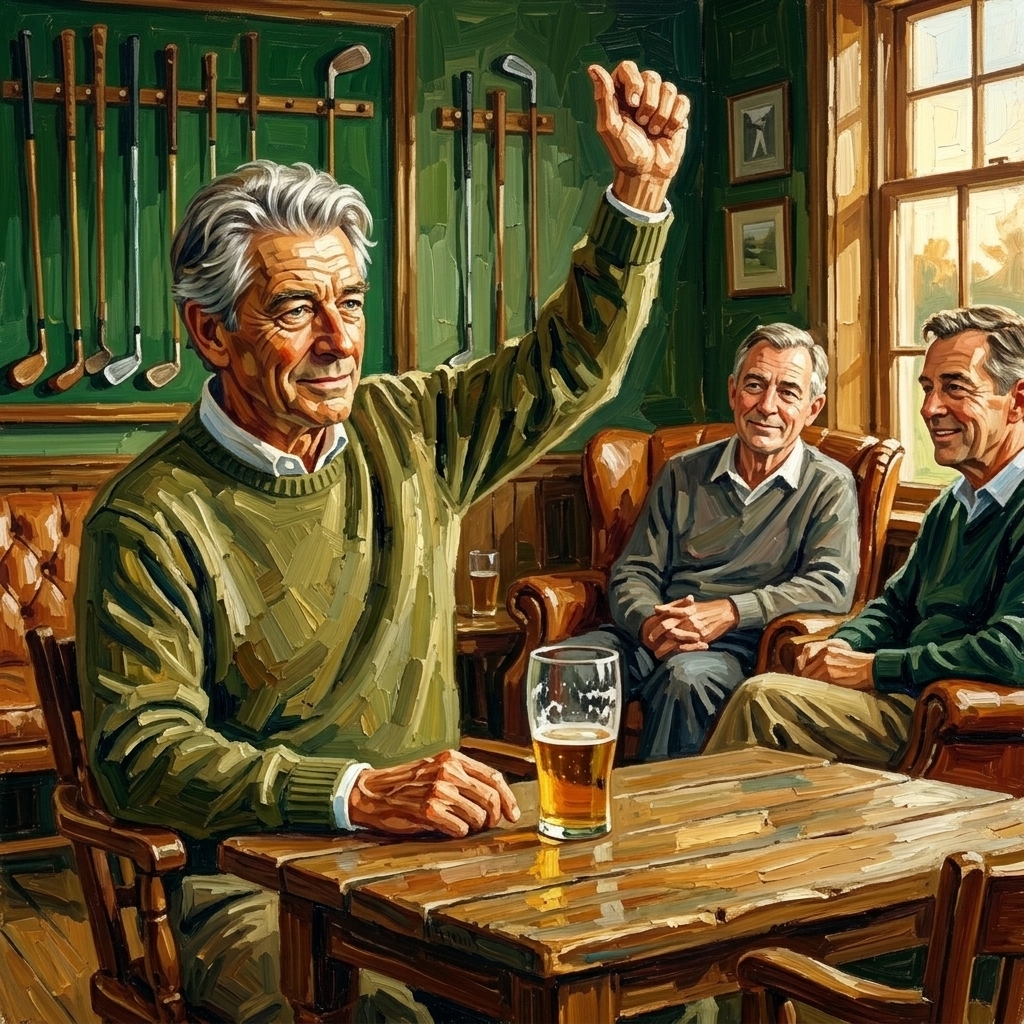
Dave's already heard about 14. I'm telling it anyway.
The golfer who relives every shot after the round isn't trying to bore anyone — he's still riding the round, and retelling it is how a good Saturday turns into a story worth keeping. The problem is never telling the story once. It's not noticing the table's already heard it, or not reading the room when the audience has quietly checked out. A handful of honest signals tell you exactly when to keep going and when to hand the floor to someone else.
Every group has one. On a good week, it's you. I earn the right to brag is one of the seven things a weekend golfer believes about himself, and it's not wrong to feel it — you played 18 holes with the same three guys, something good finally happened, and you want to tell somebody. The skill isn't suppressing that. It's knowing how long the window stays open, which is really just a small, recurring test of the social side of golf that has nothing to do with your handicap.
The Butter-Knife Backswing
Here's a version of the scene that's happened to nearly everyone reading this, in some form, at some 19th hole. Somebody hits a genuinely good shot — a punch-out from under a tree that somehow finds the green, a bunker shot that spins back to gimme range, a drive that carries a fairway bunker nobody in the group has ever carried. The group sees it happen. They react in real time, at the actual moment, with the actual excitement the shot deserves.
Then it gets told again on the walk to the next tee. Then again in the cart on 18. Then again, with a butter knife standing in for a 7-iron, at the table forty-five minutes later — three tellings for one shot, and the third one is where you lose the room.
None of those tellings are the crime on their own. A good shot deserves more than one mention; that's part of why weekend golf is fun in the first place, and it's a big part of why the round feels worth showing up for even on the Saturdays when your score doesn't. The crime is not noticing that the story's value drops with every repetition while your enthusiasm for telling it does the opposite. You're gaining energy. The table's losing interest. Those two lines cross somewhere around telling number two, and almost nobody clocks the exact moment it happens.
⛳ Why the Same Shot Gets Worse With Every Telling
- ⭐ The first telling is news. Everyone was there, but hearing it described adds something.
- 💡 The second telling is confirmation. Fine, but it's not adding much anymore.
- 🚫 The third telling is for you, not them — and everyone at the table can tell the difference.
- ✅ One clean telling, well told, beats three tellings that get progressively more defensive.
Why We Can't Just Say "I Made a Good Shot"
There's a reason nobody just says "I hit a good shot on 14" and leaves it there. A good shot in isolation is a fact. A good shot with the moment attached — what club, what lie, what you were thinking standing over it, what your buddy said right after — is a story, and stories are what actually survive from a round of golf. Nobody remembers their score from three Augusts ago. Everybody remembers the one shot that got told at the bar enough times to become part of the group's permanent record.
I'm not totally sure why this works, but the shots that make it into permanent rotation are almost never the technically hardest ones — they're the ones with a second character in them. The flop shot over the bunker isn't the story. The flop shot over the bunker while Mike was already reaching for his wallet to pay off the hole is the story. Something happened. Something changed, and that shift — Mike's hand stopping mid-reach — is doing more work in the retelling than the shot itself. That's the whole draw of what happens after the round — it's where the shot actually becomes a story, for better or worse.
There's a stranger version of this too, and it's usually how you find out a story has left your hands. Weeks later, someone who wasn't even in your group repeats a version of the flop shot back to you — half the details wrong, the yardage inflated by ten, Mike's role in it swapped to someone else entirely — because it passed through two or three retellings before it got to him. By that point it isn't really yours to correct anymore. It's the group's story now, and that's usually a sign it was a good one.
That's the real reason you want to tell it again: not vanity, mostly, but the fact that a legitimate brag is one of the few currencies a weekend golfer actually has. You're not going to win the group's respect with your handicap. You might win it with one shot, told well, at the right moment — the same unwritten code that decides who buys the round after without anyone actually saying it out loud. The problem is that "told well" and "told again" aren't the same skill, and most of us default to the second one because it's easier.
Storytelling vs. Broadcasting: Where's the Line?
There's a real difference between the guy who tells one great story about his round and the guy who narrates the whole eighteen holes like he's doing color commentary on a tape delay, and it's worth being honest about which one you were tonight.
The storyteller picks the one moment that actually has a shape to it — a shot, a bet, a moment somebody said something funny — and tells it once, tight, with the good details in and the boring ones out. He reads the table. If the story's landing, he might let it breathe for an extra line. If it's not, he wraps it and asks somebody else about their round.
The broadcaster treats the whole round as equally interesting, because to him, right now, it is. Every par gets a mention. Every three-putt gets an explanation of what went wrong mechanically. He's not being selfish — he genuinely doesn't realize that "I two-putted 11 from 30 feet" isn't a story, it's a scorecard entry read out loud.
Picture two guys walking off the same hole after the same good shot. One says: "I hit the flop shot on 14 stiff — Mike almost paid me before I even hit it." Nine words, one image, done. The other spends four minutes on the same shot: what the lie looked like, why he chose the 60-degree over the 56, how the wind was coming off the left, how it "could've gone either way, honestly." Both guys hit the identical shot. Only one of them told a story anyone's going to repeat.
The tell that separates them isn't confidence or talkativeness — plenty of quiet guys broadcast, plenty of loud ones tell one good story and stop. It's whether the person telling the story is watching the audience's reaction or watching his own memory of the shot. One of those is a conversation. The other one just happens to be occurring near other people.
How Do You Know You've Already Told This One?
Short answer: the table tells you, and it almost never uses words to do it. This is the bar's version of reading the room on the course — the signals are just as real, they're just quieter and served with a beer.
Watch what happens to the pace of the conversation, not what people say. If a story's landing, the group leans in a little, somebody adds a detail you forgot, and the next round of drinks doesn't happen until the story's actually over. If it's not landing, the pace picks back up before you're finished — someone starts flagging down the server, somebody else pulls out their phone, and the guy next to you starts nodding at a slightly faster rhythm than the story warrants, which is the universal signal for "please wrap this up."
It's kinda like telling the same joke twice at a dinner party — the first time it's a genuine laugh, the second time it's a polite one, and everyone at the table knows exactly which laugh they just gave even if nobody says so. Golf stories work the same way. The reaction on telling two is never as loud as telling one, and if you're paying attention to anything other than your own memory of the shot, you'll hear the difference.
The reliable version of this test: if you can predict word-for-word what someone at the table is about to say before you've finished your sentence, you've told it to them before. That's not a guess. That's the room giving you a very clear answer.
📍 Signs You've Already Told This One
- 🚫 Someone finishes your sentence for you — not helpfully, out of muscle memory
- 💡 The nodding speeds up before you've gotten to the good part
- 📍 A phone comes out mid-story, not after it
- ⭐ Somebody asks a genuinely new question about their own round — that's your exit
The Three-Sentence Rule
Here's the practical fix, and it doesn't require reading anyone's mind: give every shot exactly three sentences the first time you tell it, full stop. What happened, what it felt like standing over it, and the one detail that makes it a story instead of a scorecard line — a comment somebody made, a bet that hinged on it, a number that shouldn't have worked.
Three sentences is enough room for a genuinely good shot to land properly. It is not enough room to also describe your stance, your club selection reasoning, the wind direction, and what you'd been telling yourself on the range that morning. If the story needs a fourth sentence to explain itself, the shot wasn't as clean a story as it felt like in the moment — and that's fine, most shots aren't. Not every good shot needs to become a story. Some of them are just good shots, and that's allowed to be enough.
If the table wants more after three sentences, they'll ask a follow-up question. Let them ask. A story that gets pulled out of you by someone else's curiosity always plays better than one you volunteer at length, because now the table's driving instead of riding along.
What About the Group Chat?
Text threads didn't fix this problem — they just added a fourth telling. The shot gets told once on the walk to the next tee, once at the table, once more to a buddy who wasn't there that day, and then a fourth time in the group chat that night, usually with a photo of the scorecard and a paragraph that took longer to type than the actual shot took to hit.
The group chat version has one real advantage the bar version doesn't: everyone can scroll past it at their own pace instead of sitting through it live. That's also exactly its trap. Nobody's face is giving you feedback while you type, so it's easy to keep going well past the point where the story earned its length — a full paragraph explaining club selection and wind direction gets sent out anyway, because there's no polite nod slowing you down or telling you the table's had enough.
The fix is the same one that works in person: pick the one detail, keep it to a few lines, then stop. If the thread wants more, somebody will ask a follow-up, or you'll get back the one reaction that means it actually landed — and that's worth more than a paragraph three guys skimmed and nobody finished.
When It's Your Buddy Who Won't Let It Go
Sooner or later this isn't about you — it's about the guy across the table who's now on his fourth telling of a bunker shot from three holes ago, and the rest of the group has started exchanging the specific look that means "somebody needs to redirect this."
The instinct is to interrupt with a joke, which sometimes works and sometimes just makes him defensive and dig in harder. The move that actually works more often: ask him a real, specific follow-up question about something else from his round — not the shot he's stuck on, a different one. "What happened on your tee shot on 9?" does more to reset the conversation than any version of "okay, we heard you" ever will, because it gives him a new story to tell instead of asking him to stop telling the one he's on. This is the exact low-grade friction foursome dynamics are made of — nobody's actually mad, but somebody has to move the conversation before the table gets restless.
This is making your foursome better in its least glamorous form — not the big gestures, just quietly steering a stuck conversation somewhere it can actually go. Nobody remembers who did this at the table. Everyone remembers if nobody did.
🔧 Redirecting a Buddy Who's Stuck on One Shot
- ✅ Ask about a different hole in his round — not "let's move on," a genuine new question
- 🔧 Bring up your own shot from the same stretch — shared spotlight beats a solo one
- 🚫 Don't say "you already told us" out loud — it lands harder than it needs to
- 💡 If he's genuinely proud of it, let it have its one great telling before you redirect
Why the Short Version Is the One People Actually Remember
I used to tell the whole round, front to back, every time — every fairway, every three-putt, the full eighteen holes in chronological order whether anyone asked or not. After watching more than a few conversations quietly die around hole 6 of the retelling, I started cutting it down to one shot, told once, and letting the rest of the round go unmentioned unless somebody asked. Now the one story I tell is the one people actually bring up two weeks later — the full eighteen-hole version never got repeated by anyone but me.
That's the part almost nobody believes until they try it: the shorter version isn't the compromise. It's the better story. A single well-placed shot, told once with the right detail in it, does more work for your reputation at the table than an hour of complete and accurate coverage ever will. What actually counts as a legitimate brag is never the length of the account — it's whether the table wants to repeat it to somebody who wasn't there, and bragging rights expire fast enough that the story is really all you get to keep. That's the only scoreboard that matters, and it rewards editing, not volume.
What Actually Makes a Story Worth Retelling
🎯 What Actually Makes a Story Worth Retelling
- ⭐ One shot, told once, beats the full round told from memory in chronological order
- 💡 The room tells you when you've already told it — watch the pace, not the polite words
- 🔧 Three sentences is the right length for a first telling; a follow-up question earns you more
- ⛳ A story that gets repeated by someone else, later, is the only real measure of a good one
🏌️ Got a Golf Story?
Share it with us. Every story we publish earns the author a free copy of The Weekend Golfer's Social Playbook — our three-step system for finding your people, running trips that actually come together, and earning the right to brag at the 19th hole.
Or join the Golfeasers — free weekly content for people like us.
Questions From Guys Who've Told the Story Too Many Times
How many times can you tell the same golf shot story before it gets old? Once, told well, to any given table. A second telling is fine if someone specifically asks to hear it again — that's an invitation, not a repeat. A third telling to the same audience is almost always for your own benefit, not theirs, even when it doesn't feel that way in the moment.
Is it rude to interrupt someone retelling a golf shot? A direct "you already told us" can land harder than intended, even said kindly. Redirecting with a genuine question about a different part of their round works better than a correction — it moves the conversation without making anyone feel shut down.
What's the difference between telling a good story and bragging? A good story includes the table — a detail, a laugh, a moment somebody else was part of. A brag is just the outcome, repeated, with the listener's reaction left out of the equation. The same shot can be either one depending on how it's told.
Why do golfers care so much about talking about their round afterward? Because the round itself is over fast and the story is what's left. For a group that plays once a week for the friendship as much as the golf, the retelling is doing real work — it's how a Tuesday-forgettable Saturday becomes something the group still brings up at Christmas.
Why does the same story land differently depending on who's telling it? Partly timing, partly trust. A story told by someone who reads the room and stops at the right moment earns more attention over time than someone who over-tells every round — the group starts listening harder to the guy who's editing himself, because they know he wouldn't be telling this one if it wasn't worth it.
More From the 19th Hole
- The 19th Hole: Why What Happens After the Round Matters Most
- How Long You're Supposed to Stay at the 19th Hole
- Telling a Golf Story at the Bar So Non-Golfers Don't Zone Out
- The Awkward Moments: Golf's Most Universal Embarrassments

Johnny is a 25-year weekend golfer who's double-booked tee times, forgotten his clubs an hour from the course, and made pretty much every other trip-planning mistake there is — so you don't have to. Guided by The Golfeaser Manifesto, he started Golfeaser.com to prove that weekend golfers are a special, funnier breed who improve the experience, not just the scorecard. He's also the guy behind The Weekend Golfer's Social Playbook — a three-step system for finding your people, running trips that actually come together, and earning the right to brag at the 19th hole.
