- Home
- Games & Bets
- Game Formats A–Z
- Vegas
Vegas: The Foursome Game Where a Bogey and a Par Can Turn Into a Bloodbath
Somebody says "Vegas" on the first tee, and three guys nod like they know exactly what that means. One of them does. The other two are nodding because admitting you don't know the rules of a betting game, thirty seconds before it starts costing you money, feels worse than just losing.
Mike used to be one of the nodders. Now he just quietly opens his banking app before he even tees off on 18, because he already knows roughly what he owes.
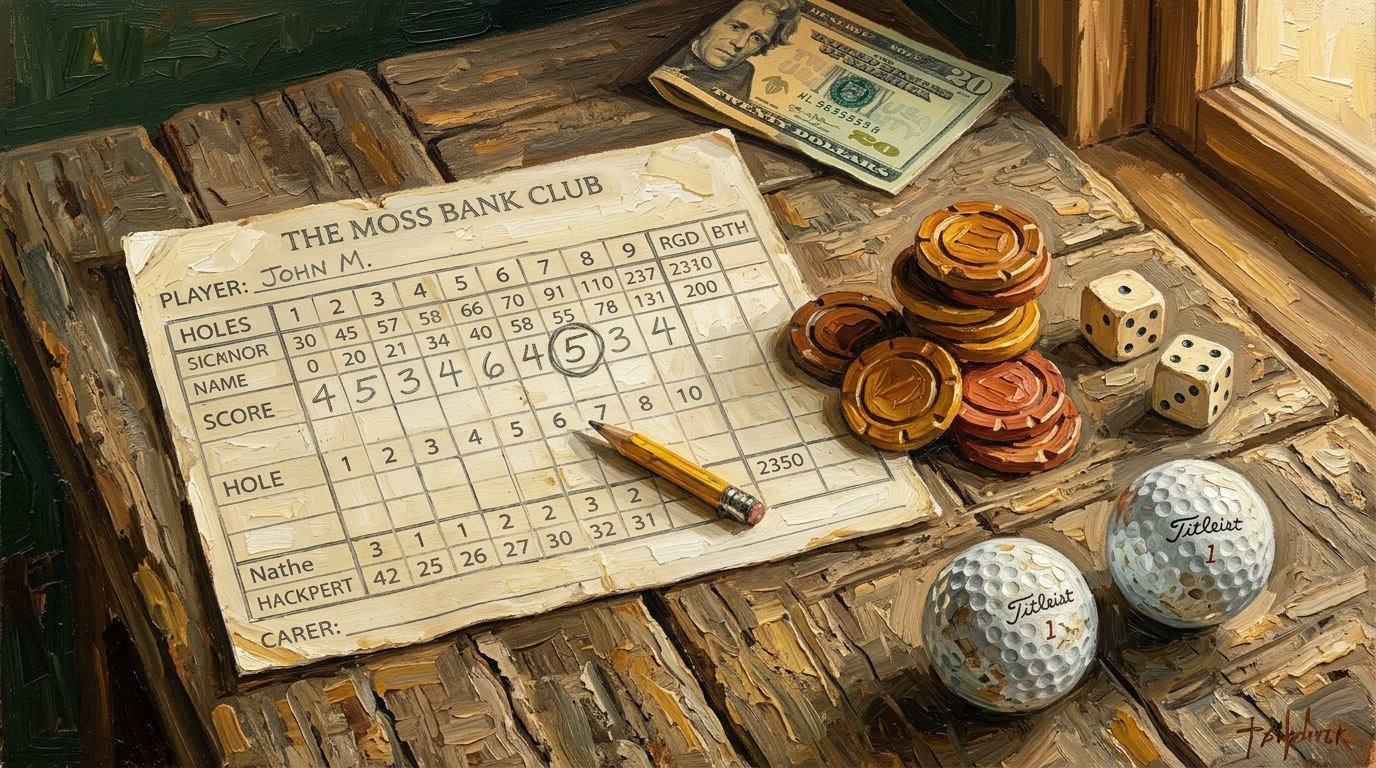
Mike still won't say what number Vegas gave him on 11. Some questions you just let a man keep to himself.
Here's the short version: Vegas is a two-vs-two betting game where each team's hole score combines into a two-digit number — low score first, high score second — and the team with the lower number wins the difference in points. A natural birdie flips the other team's number around, and an eagle flips it and doubles the points — which is how one average hole turns into a number nobody wants to say out loud.
That's the whole game in one paragraph. The rest of this is what actually happens when you play it — the math nobody explains right, the flip that catches new players off guard every single time, and how to set it up so it's the highlight of the round instead of the reason somebody drives home in silence. None of that requires you to be the best golfer in the group — it just requires you to be the guy who actually understood the game before everyone else did, which is its own quiet way of making the foursome better.
What Is Vegas, Exactly?
Vegas is one of the entries in our full Game Formats A-Z library — part of the wider world of golf group games that make a Saturday round worth talking about later. It's a four-player betting game played in two-man teams for all 18 holes — no rotating partners, no reshuffling at the turn. You pick your partner (or get assigned one), you agree on a per-point value before the first tee, and then the two of you are stuck with each other's scores, for better or worse, until the 18th green.
The name comes from the scoring gimmick: instead of comparing strokes hole by hole, each team's two individual scores get mashed together into a single two-digit number, like a hand of cards. Low man's score goes first, high man's score goes second. A 4 and a 6 isn't "ten strokes between you" — it's the number 46.
Whichever team's number is lower wins the hole. The margin between the two numbers is how many points change hands. That's what makes Vegas feel different from a normal Nassau — the swings aren't linear. A team that's only one stroke worse on paper can lose a hole by twenty points or more, because of what happens to their number once it gets combined and, sometimes, flipped.
Here's the thing nobody talks about when they explain Vegas: the game isn't really testing who golfed better on a given hole. It's testing whether your team's number held up — and that number can betray you in ways that have nothing to do with how you actually played.
How the Two-Digit Score Actually Works
Say Jim and Dave are playing Vegas against Johnny and Mike on a par 4. Jim makes a 5, Dave makes a 6. Low score first: their team number is 56. Johnny makes a 4, Mike makes a 5 — Team Johnny/Mike is 45.
Lower number wins, so 45 beats 56. The difference — 56 minus 45 — is 11. That's 11 points to Johnny and Mike's side, multiplied by whatever the group agreed a point is worth. At a quarter a point, that's $2.75 each. At a dollar a point, that's a very different Saturday.
Notice what didn't happen here: nobody birdied, nobody choked, nothing dramatic occurred. It was just two ordinary scores on both sides, and one team's combination happened to be a smaller number. That's most of Vegas, most of the time — small, steady swings on ordinary holes. It's the other kind of hole, the one with a flip in it, that people remember.
🎯 The Vegas Math, Boiled Down
- ⭐ Low score on the team comes first, high score comes second — 4 and 6 becomes 46, not 64
- 💡 The team with the smaller combined number wins the hole
- 🔧 Points equal the difference between the two numbers, multiplied by your agreed stake per point
- ⛳ A one-stroke edge on paper can still be a small-point win — the number swing usually matters more than the raw strokes
The Flip Rule: Where Vegas Earns Its Name
This is the part that trips up every group the first time, and it's also the entire reason people keep playing Vegas instead of a plain Nassau. If a player makes a natural birdie — no strokes, no gimme charity, an actual birdie — the opposing team's number flips. High digit moves to the front, low digit moves to the back. A 46 becomes 64. Suddenly the team that shot a completely respectable bogey-and-par is staring down a number that looks like a disaster, because in Vegas terms, it just became one.
If a player makes an eagle, the effect stacks: the opposing team's number flips and the point differential doubles. That's the hole people actually remember — the one where a great shot on one side turns an unremarkable hole on the other into the single biggest swing of the round.
There's one mercy built into the rule: if both teams birdie or eagle on the same hole, the flips cancel out and the hole scores normally. Golf being golf, that happens a lot less often than you'd hope.
I'm not totally sure why this catches people off guard every single time, but it does — you can explain the flip rule on the first tee, watch everyone nod, and still get "wait, what just happened?" by hole 6.
Here's how it actually plays out over a real three-hole stretch — Johnny and Mike against Jim and Dave, same stakes, same foursome, one Saturday.
Look at hole 2 again. Team A's actual golf wasn't a disaster — a bogey and a double bogey on one hole is a bad stretch, not a catastrophe. But because it happened on the same hole Jim made a birdie, that ordinary 56 became a 65, and a hole they'd have lost by a couple of points anyway turned into a 31-point wipeout. That's the entire personality of Vegas in one example: it's rarely your worst golf that costs you the most. It's your worst golf landing on the wrong hole.
How Points Turn Into Money (And Who Pays Whom)
Every hole's point differential adds to a running total for each team. At the end of 18, you've got a net number — Team A up 40, say, or Team B up 15. Multiply that by the agreed value per point, and that's the total wagered for the round. It typically gets split between the two players on the losing side, paid to the two players on the winning side.
Most groups set the value low to start — a nickel or a dime a point until everyone's comfortable with how fast the numbers move. Vegas points can swing 20, 30, even 40 in a single hole once a flip is involved, which means a stake that felt reasonable at a quarter a point on hole 1 can feel very unreasonable by hole 9 if nobody thought it through first. If your group is still figuring out what a fair stake actually looks like, how much to bet on golf with friends is worth reading before you set the number, not after.
Settling up works the same way most group bets do — cash, an app, or a running tab that gets squared at the 19th hole. If your group still argues about who owes what by the time you're back at the clubhouse, that's a settling-up problem, not a Vegas problem, and how to settle golf bets without anyone getting mad covers it separately.
Keeping Score Without Slowing Down the Round
The one practical failure mode nobody warns you about: four guys standing on a tee doing two-digit subtraction in their heads instead of hitting. Vegas moves fast when you let it, and drags when you don't.
Write the running point total on the card next to the strokes, not just the strokes themselves — one extra column, updated at the green before anyone walks off it. Settle any disagreement about a hole's number right there, while both scores are still fresh, instead of carrying it to the next tee where it turns into a longer argument with less information. And if a flip happened, say the new number out loud once — "that's a flip, so it's 65, not 56" — so nobody's still doing math three shots later. It's a small habit, but it's the difference between Vegas being the fun part of the round and Vegas being the reason you're the slow group.
Vegas vs. Nassau: Which Fits Your Group?
Nassau is the game most groups already know — three separate bets (front nine, back nine, overall) decided stroke by stroke, individual against individual or team against team, with steady, predictable stakes. You can more or less guess what a Nassau round is going to cost you by the turn.
Vegas throws that predictability out. The two-digit combination means small differences in play produce outsized swings, and the flip rule means a single well-timed birdie can be worth more than an entire hole's worth of good golf on the other side. If your group wants a bet that stays calm and rational, Nassau, explained is the safer choice, and the full Wolf vs. Nassau breakdown covers the same "how wild do you want this" question from a different angle.
If your group wants the bet that makes people actually watch each other's second shots on par 5s — because a teammate's eagle putt might just double your points — Vegas is the pick. It rewards paying attention to your partner's ball almost as much as your own, which is a different kind of fun than Nassau's steady grind.
Where Vegas Goes Wrong (And How to Avoid It)
Dave hosted a work trip a couple summers back and introduced Vegas to four guys who'd never played it. Nobody set a cap. Nobody explained the flip rule past a single sentence on the first tee. By hole 13, one team was down more than 200 points, doing math on their phones between shots instead of talking, and the round finished in near silence.
That's not a Vegas problem. That's a setup problem, and it happens the same three ways almost every time.
No cap on the swing. Vegas points move fast, and without an agreed ceiling — a maximum points differential per hole, or a maximum total for the round — one bad flip can turn a friendly $20 bet into a genuinely uncomfortable number. Cap it before you start, not after someone's already down 150.
Mismatched handicaps with no adjustment. If one team is materially better than the other, the flip rule doesn't fix that gap — it amplifies it, because better players birdie more often, which means their team triggers more flips against the other side. Vegas needs the same handicap conversation any team game does; making the game fair covers how most groups actually handle that instead of pretending everyone's equal.
Nobody actually understood the flip before hole 1. "It's like Nassau but the numbers flip sometimes" is not an explanation, and it's how you end up with a guy arguing on the 6th green that his birdie should've helped his own team's number, not hurt the other guy's. Walk through one full example — out loud, before anyone tees off — and the arguments mostly disappear.
🚫 The Three Ways Vegas Goes Sideways
- 🚫 No cap on how far a single hole's points can swing
- 📍 A big handicap gap between teams with no adjustment agreed in advance
- 💡 Explaining the flip rule in one sentence instead of one worked example
- ✅ Fix all three on the first tee — none of them are fixable by hole 13
Something happened. Something changed on that trip of Dave's the second time around. They played Vegas again the next year, capped at 15 points a hole, walked through one full example before teeing off, and it became the thing people brought up unprompted at dinner that night. Same game. Different setup.
Variants Worth Trying
Once your group has the base game down, a few common tweaks are worth knowing about, even if you never use them:
Newtown. Instead of the two outside balls (furthest left, furthest right) being partners, the two middle balls pair up. It rewards accurate ball-striking off the tee more than the standard partner split, and it's a popular way to keep a regular Vegas group from getting stale.
Presses. Some groups let the losing team "press" mid-round — starting a fresh side bet for the remaining holes to claw back losses faster. If your group already uses this in Nassau, the press, explained covers the mechanics; it layers onto Vegas the same way.
Hammer-style doubling. A handful of groups borrow the doubling language from Hammer, letting a trailing team call for double points on the current hole before it's finished. It's not part of standard Vegas, and it stacks badly with the eagle-double rule if you're not careful — decide before the round whether you want two different doubling mechanics fighting each other on the same hole.
None of these are required. The base game — two teams, two-digit numbers, one flip rule — is plenty for most Saturday foursomes, and adding variants before everyone's comfortable with the fundamentals is usually how you end up back at the "nobody understood the flip" problem.
Setting Up Vegas With Your Foursome
Do you need exactly four players? Yes — Vegas is built around two teams of two. If you're short a player, what to play when only two of you show up covers better options than trying to force Vegas into a threesome.
How do you pick teams? Random is the fairest and the fastest — flip a tee, pull cards, whatever your group already does. Picking teams by ability without adjusting stakes just recreates the mismatched-handicap problem before the round even starts.
What stake should a new group start at? Low. A dime a point is enough to make people care without making anyone anxious, and you can always raise it hole by hole if the group's comfortable. Nobody has ever regretted starting a new bet too small.
Do you need a cap? Yes, always, and set it before hole 1 — a maximum swing per hole (most groups land around 15–20 points) keeps one unlucky flip from deciding the whole round by itself.
What if someone doesn't know their own score fast enough to combine it? Slow down. Vegas requires both scores to be locked in before you can call the hole, and rushing it is how disputes start. It's fine to finish a hole, confirm both numbers out loud, then write it down.
Fellow Golfeasers who've run this with a new group all say some version of the same thing: the explanation takes two minutes, and it saves the other three hours. That's the whole trade — and being the guy who can run that two-minute explanation cold, without fumbling the flip rule, is its own quiet way of being the guy your group wants organizing next Saturday too.
What to Lock In Before Somebody Says "Vegas"
You don't need to be good at golf to run a clean Vegas round — you need one guy at the first tee willing to say "here's exactly how the flip works" out loud, with a real example, before anyone hits a shot. That's it. That's the whole difference between the version of this game people request again and the version that ends in silence on 18.
⛳ Everything You Need Before the First Tee
- ⭐ Two fixed teams of two, all 18 holes — no rotating partners
- 🔧 Combine each team's score low-first, high-second; lower number wins the hole
- 💡 A natural birdie flips the opponent's number; an eagle flips it and doubles the points
- 📊 Set the stake low, cap the swing per hole, and walk through one full example before teeing off
That two-minute explanation is the difference between Vegas becoming your group's new standing request and Vegas becoming the game somebody vetoes before the next trip. Worth the two minutes.
Vegas Golf Game: Quick Answers Before You Tee Off
Can you play Vegas with a threesome instead of a foursome? Not really — the two-vs-two math is the entire structure of the game. With three players, you'd need a rotating format or a different game entirely; a Nassau or a Wolf-style rotation handles an odd number far better.
Does a net birdie (using a handicap stroke) trigger the flip? Most groups only flip on natural birdies, not net ones, specifically because letting handicap strokes trigger flips makes the game swing even harder toward whoever's getting the most shots. Agree on this before the round — it's the second most common argument after "wait, what just happened."
What happens if both teams get the same combined number on a hole? It's a push — no points change hands, and you move to the next tee. Ties happen more than you'd think once you're actively trying to keep your number low.
Is Vegas a good game for a group with very different handicaps? Only if you build in an adjustment — usually a stroke or two given to the weaker team based on the handicap gap, agreed before the round. Without it, the better team's extra birdies trigger flips constantly, and the game stops being fun for whoever's on the losing end of that math all day.
How is Vegas different from just doing a team match play bet? Match play compares strokes hole by hole in a straightforward way. Vegas compares combined two-digit numbers, which is what creates the outsized swings and the flip rule — it's a fundamentally different kind of bet, not just a variation on the same idea.
🏌️ Got a Golf Story?
Share it with us. Every story we publish earns the author a free copy of The Weekend Golfer's Social Playbook — our three-step system for finding your people, running trips that actually come together, and earning the right to brag at the 19th hole.
Or join the Golfeasers — free weekly content for people like us.
Keep the Bets Interesting Before Your Next Round
- The Skins Game, explained
- Best Ball vs. Four Ball: the difference your group keeps getting wrong
- Sandies, Barkies, and Arnies: the trash bets every group half-remembers
- Stableford: the scoring system that makes bad holes cheap
- Daytona: the team game that rewards your worst player too

Johnny is a 25-year weekend golfer who's double-booked tee times, forgotten his clubs an hour from the course, and made pretty much every other trip-planning mistake there is — so you don't have to. Guided by The Golfeaser Manifesto, he started Golfeaser.com to prove that weekend golfers are a special, funnier breed who improve the experience, not just the scorecard. He's also the guy behind The Weekend Golfer's Social Playbook — a three-step system for finding your people, running trips that actually come together, and earning the right to brag at the 19th hole.
