- Home
- Weekend Golfer Life
- Golf Quotes
- Nobody Remembers Your Score, Everybody Remembers Your Cart
The Scorecard You Forget, The Cart You Never Do: A Golfeaser Quote
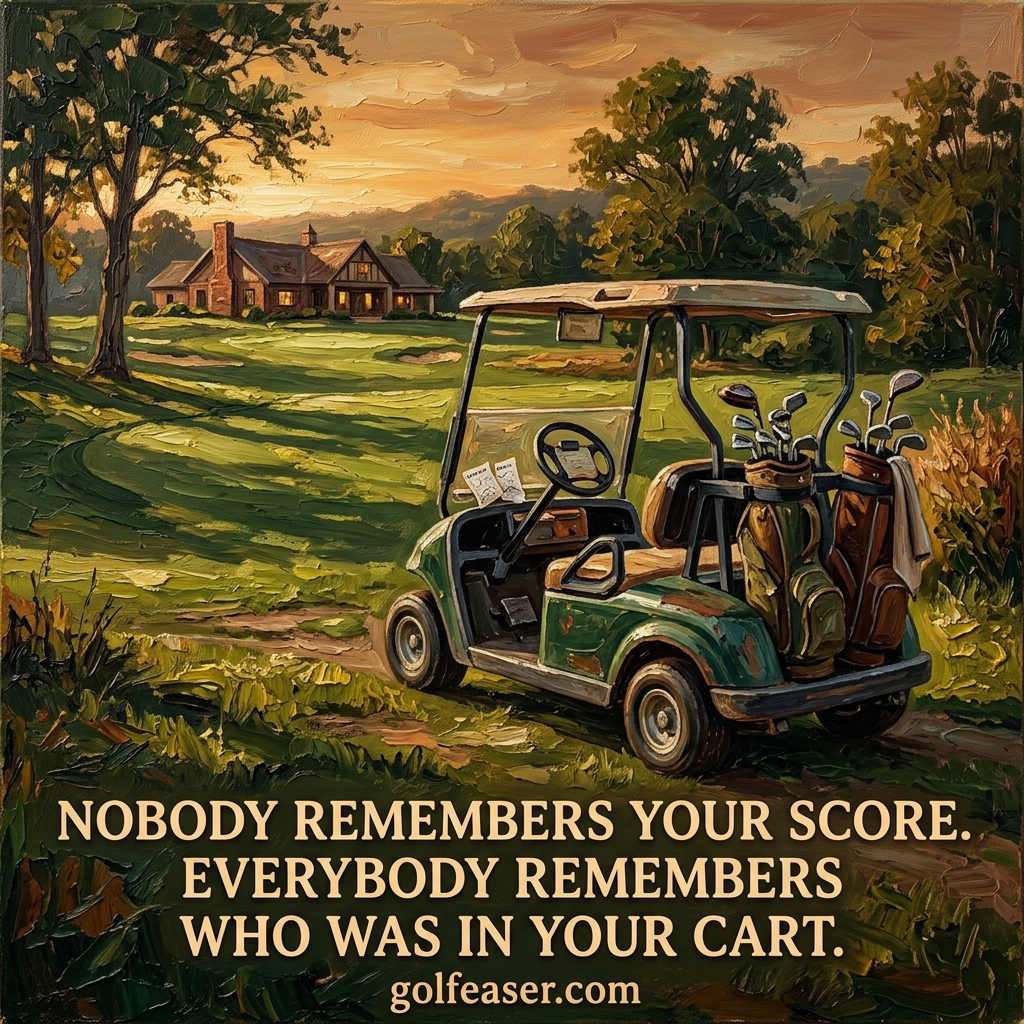
Quick test. What did you shoot last Saturday?
If you had to think about that for more than two seconds, that's already the whole argument. Now try the other question — who was sitting next to you for four hours? You knew that one instantly. No math required, no scorecard to dig out of your bag to double-check.
That gap between the two answers is what this quote is about. Not that the score doesn't matter at all — it matters for about as long as it takes to sign the card and hand it back. What actually survives the drive home is almost never the number.
So Why Do We Even Keep Score?
Because someone has to, technically. Because a round without a number attached feels like it didn't officially happen. Because there's a small, stubborn part of every one of us that still wants proof we're getting better, even on the Saturdays where the evidence says otherwise.
None of that's wrong. I'm still chasing a good number same as anyone — that's not the point I'm making here. The point is what happens to that number the second you're not actively looking at the card anymore.
Try this yourself. Pick a round from two summers ago — any round, doesn't matter which course. Now try to recall the exact score. For most guys, that number is just gone. What's still sitting there, fully intact, is the guy who was in the cart with you, what he said on twelve, and probably one very specific, very stupid joke that's still somehow funny.
Except When It Isn't — And Here's Why That Actually Proves the Point
Fair objection, and I'll take it seriously: some scores do stick. I remember the exact number the first time I broke 90 — an 87, at a course I hadn't played before, on a Tuesday twilight round that wasn't even supposed to happen. That one's permanent. So the rule isn't absolute, and it would be dishonest to pretend otherwise.
But look closer at why that particular number survived when a hundred others didn't. It's not the 87 itself doing the work. It's that Mike was in the cart when I signed the card, and he made me read the number out loud twice like it was a legal document, and then he wouldn't let it go for the rest of the season. Strip the audience out of that memory and you're left with a fact on a piece of paper — the kind of fact that evaporates by October. The number only became a story because someone else was there to turn it into one.
That's the actual test. Ask yourself honestly whether the scores you remember are the ones nobody witnessed, or the ones somebody made a big deal out of in the cart on the way to the clubhouse. For almost everyone, it's the second kind, every time.
The Round Nobody Remembers the Number For
I can tell you almost nothing about my score from a Saturday nine years ago at a scrappy little municipal course outside town. I know it wasn't good — the back nine had a par-5 with a pond that ate two of my balls, and I remember being annoyed about it in the moment. That part's gone into the fog with everything else.
What I remember with total clarity: Dave, riding shotgun, eating pretzels out of a bag he'd smuggled from the clubhouse vending machine, narrating my entire back nine like it was a horror movie. "And now he approaches the water for the second time." He wasn't even that funny, objectively. It's funny now purely because it's Dave, and because I can still hear exactly how he said it.
Mike asked me what changed about our Saturdays somewhere around year six of playing together, and at the time I didn't have a real answer for him. I think this is it. Somewhere in there, without deciding to, we all quietly stopped playing for the score and started playing for the cart. The golf became the reason we were there. The cart became the actual event.
🎯 What Actually Outlasts the Scorecard
- ⭐ The joke someone made on a hole you can no longer name
- 💡 The exact tone of voice, not the words — you'll forget the words first
- ⛳ Who was in the cart, almost always, before what you shot
- 🚫 The number itself — gone within a season, most of the time
What Actually Sticks After Eighteen Holes
Ask any weekend golfer to describe a great round from a few years back and watch what comes out first. It's never "I shot an 84." It's "we played with those two retired guys who kept betting on everything," or "that was the round Jim's cart got stuck in the bunker and we had to push it out." The round worth telling about at the 19th hole almost never turns out to be the round with the best number attached to it. Usually it's the round where something went sideways enough that it became a story.
There's a reason for that, and it's not complicated. A score is a fact. A story needs a person in it — ideally someone with a personality, a bad haircut, a habit of narrating your misses — for it to be worth repeating. The scorecard has none of that. The guy in your cart has all of it.
I'm not totally sure why this works the way it does, but I've noticed the rounds I remember worst score-wise are frequently the rounds I remember best overall. The bad round with the right guy in the cart beats the clean round with a stranger, every single time, and it's not close.
The Rotating Cast of Guys Who've Ridden Shotgun
Twenty-five years of Saturday golf means a lot of different guys have sat in the passenger seat of my cart, and I can sort most of them into a type without much effort. There's the narrator, like Dave, who provides live commentary on your round whether you want it or not. There's the strategist, who wants to talk through your club selection on every single shot like he's caddying for you, unpaid and uninvited. There's the quiet one, who says maybe forty words over four hours and somehow you still leave feeling like you had a great conversation.
None of those guys are memorable to me because of anything they shot. I genuinely couldn't tell you most of their scores from the rounds I'm thinking of right now. I could, without effort, do a passable impression of how each of them talks, what they complain about, and what specific thing they say right before a big putt.
There was a stretch of maybe two years where I played almost every Saturday with a guy named Jim who had exactly one joke, told at exactly one moment — right after anyone in the group hit a shot into the water, he'd say "well, at least it's not on the fairway," completely deadpan, every single time, like he'd never said it before. It stopped being funny around the fourth time. It's been funny again every time since, purely because it's Jim's bit and we all know it's coming. I couldn't tell you a single score from that stretch of golf. I could recite that line in his exact cadence right now.
Why Golf Makes This So Obvious (And Running Never Will)
Here's a comparison that might sound strange at first: think about a solo pursuit like running or lifting, something plenty of guys our age also do to stay in shape. Nobody who runs three miles alone at 6 a.m. comes home and can't remember their time but vividly remembers who was jogging next to them — because nobody was. The activity is the whole point, because there's no cart.
Golf is structurally different, and I don't think that's an accident of history so much as it's the actual reason the game has survived this long as a social institution instead of just a sport. Four hours, same small group, forced proximity, built-in downtime between shots that has to get filled with something. You end up talking. You end up learning things about your buddy's kid, his job, his marriage, that you'd never have found out over a beer in an hour because an hour isn't long enough to get past the small talk.
The dynamics of your specific foursome aren't a side effect of playing golf together — they're arguably the actual product golf is delivering you, wrapped in a sport so it doesn't feel like you're just showing up to talk to your friends, which would apparently be too on-the-nose for most men to admit to wanting on purpose.
The Cart Is Where the Real Golf Happens
Here's the thing nobody talks about when they explain golf to someone who's never played: the actual game — the swings, the putts, the approach shots — takes up maybe forty minutes of spread-out action across a four-hour round. Everything else is cart time. Walking time. Standing-around-waiting-on-the-group-ahead time.
That's not a flaw in the sport. That's basically the whole appeal, if you're honest about why you keep showing up. Who needles who, who's steady, who complains about the greens every single week without fail — that's the actual content of a Saturday morning, and it's a big part of what life as a weekend golfer actually is once you strip the swing thoughts away. The golf is just the excuse everyone agreed on so they could go do this without it being weird.
I make my foursome better mostly by being reliably there and reliably willing to laugh at myself first. That's a low bar, and I've cleared it for twenty-five years running, which honestly might be the most impressive stat on my whole golf résumé. Making the group better isn't about your handicap — it's about showing up as someone the other three guys actually want in the cart next to them.
A buddy of mine put it kinda like a long-running group chat that happens to require clubs. Nobody's re-reading old messages for the information. They're there because the people in it are the people they want to keep talking to, and the topic is mostly beside the point.
Why This Is Harder to Admit Than It Sounds
Here's where I'll be honest about the part that's actually uncomfortable. A lot of us — myself very much included, for a good chunk of my twenties and thirties — genuinely believed the score was the point, and treated a bad round like it meant something about us personally. Slammed a club back into the bag a little too hard more than once. Went quiet in the cart for a hole or two, punishing everybody else for my own three-putt.
It took embarrassingly long to notice that nobody else in the cart cared about my score nearly as much as I did. They cared whether I was fun to be around for four hours. Those turned out to be two completely different things, and only one of them was actually in my control on any given Saturday.
Whether golf friends count as real friends is a question I used to genuinely wonder about, back when I thought the friendship was downstream of the golf being good. It isn't. The golf is downstream of the friendship — the golf just gives it a reason to happen weekly instead of whenever everyone's calendars happen to align, which for grown men with jobs and kids is approximately never.
What This Means the Next Time You've Got an Open Spot
This matters more than it sounds like it should when you're actually filling a fourth. It's tempting to grab whoever's free, or whoever's the best golfer available, on the theory that a stronger group means a better round. I've done that. It rarely works out the way I hoped.
The rounds that turned into stories weren't the ones where the fourth guy shot the lowest number. They were the ones where the fourth guy was actually good company for four straight hours — someone who could take a joke, someone who didn't sulk after a bad hole, someone who'd still be talking to you on eighteen the same way he was on one. A great player who's miserable company empties the cart out just as fast as a bad player who's miserable company. The handicap was never really the variable that mattered.
I'd rather play with a 20-handicapper who laughs easily than a scratch golfer who's silently grinding through his own round like the rest of us aren't there. That's not humility talking — it's twenty-five years of evidence, and it's the same evidence behind the idea that your best round is always the next one, not the one on the card right now. The guy who makes the foursome better is almost never the guy with the best card. He's the guy you'd choose to be stuck in a cart with even if the golf course caught fire and you had nothing to do but sit there and talk for an hour.
The Whole Reason We Still Show Up
None of this means stop trying. Chase your good drives, care about your score for the two hours you're actually playing, argue about the Nassau like it matters — it's more fun when it does. Just don't confuse that with the actual reason you keep booking the tee time year after year.
Golf builds friendships you'd never have picked up any other way, mostly because it manufactures four uninterrupted hours with the same people, on a schedule, for years. Almost nothing else in adult life does that automatically. That's the actual, quietly remarkable thing golf is doing for you, underneath all the complaining about your slice.
You're always just one round away from a bad Saturday turning into the story you tell for a decade — but only if the right guy's in the cart when it happens. What happens after the round, at the 19th hole, is usually where that story actually gets told for the first time, retold badly, and locked in forever. The scorecard's long since been thrown out by then. Nobody misses it.
I still have the scorecard from that Tuesday twilight 87, actually — folded up in a drawer somewhere I haven't opened in years. If I'm honest, I kept it more for Mike's reaction than the number itself. The number's just ink. What I was really holding onto was the sound of him making me read it out loud twice.
Next Saturday, when you're signing the card and someone asks what you shot, go ahead and tell them. Just don't be surprised when, two years from now, that's the one detail from the whole day that's completely disappeared — while the guy who ate all your pretzels is still, somehow, exactly as clear as if it happened last week.
More Lines Worth Screenshotting
Golf Quotes From a Guy Who Never Broke 90
One-line quotes about weekend golf, from a guy who plays for the stories and the 19th hole, not the scorecard.


Johnny is a 25-year weekend golfer who's double-booked tee times, forgotten his clubs an hour from the course, and made pretty much every other trip-planning mistake there is — so you don't have to. Guided by The Golfeaser Manifesto, he started Golfeaser.com to prove that weekend golfers are a special, funnier breed who improve the experience, not just the scorecard. He's also the guy behind The Weekend Golfer's Social Playbook — a three-step system for finding your people, running trips that actually come together, and earning the right to brag at the 19th hole.

